

• Adam Smith Institute

    Adam Smith Institute place holder
  • Philosophy & Logic

    Philosophy and Logic
  • Cambridge

    Cambridge
  • Children’s SF

    Children's Science Fiction
  • Enter your email address to follow this blog and receive notifications of new posts by email.

    Join 428 other subscribers

Prof Brian Cox considers the possibility of Time Travel

tardisTo mark half a century of its “Doctor Who” science fiction drama series, the BBC is laying on a programme of special events that includes an hour-long talk by Prof Cox at the Royal Institution.  So is the Tardis used by Doctor Who to flip across the centuries a viable prospect?  Prof Cox says it is for travel into the future.  You can do that by travelling in space at near light speeds and returning to find that more years have passed on Earth than you experienced in space.  A simpler way might be to put yourself into suspended animation in a well-protected sealed chamber, only emerging when your desired number of years has passed.  Either way you find yourself much younger than the world you re-enter.

But what about the return trip?  This is where we hit problems.  The universe’s speed limit says we cannot convey information through space faster than light can cross it.  Science fiction writers, myself included, have sought to circumvent this limit by having vehicles leave conventional space-time and returning to it elsewhere.  A wormhole is like a tunnel that takes you out of the universe at one point and puts you back into it at another.  This could theoretically work for time as well as space.  Two Russian mathematicians have suggested that the Large Hadron Collider at Cern could be used to create tiny wormholes.  Of course it is possible that we might discover some effect in the universe that exerts its influence in less time than it takes light to travel.  If we did, we might be able to modulate it to send signals.

Then the paradoxes come into play.  If a man goes back and kills his father before he was conceived, does he disappear, and therefore not be able to kill his father?  Isaac Asimov solved most of these in “The End of Eternity.”  In that work time travellers do indeed alter the past, but are protected by an aura of ‘physiotime’ that shields them from any changes they have made that might affect their own person.  And except at the end of the book, he postulates that time travellers cannot go farther back in time than the invention of the first time field.  It’s well worth a read, and it’s a lot cleverer than “Doctor Who.”

Graphyne and graphene both hold the promise of improved and cheaper desalination

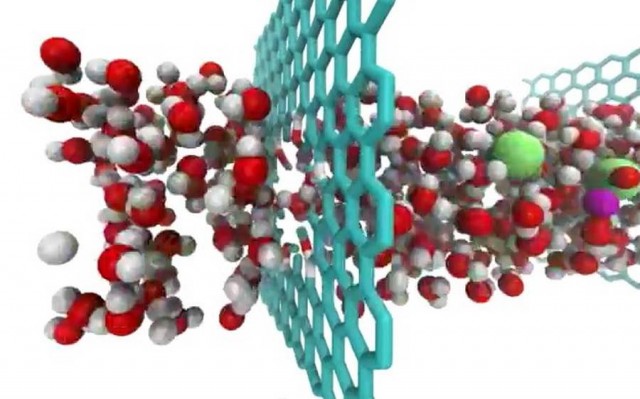
Desalination-grapheneI’ve written about osmosis before, and I think it likely that it will be the future way of desalinating seawater.  Eco-maniacs give doom-laden predictions of future “water wars” and urge us to move to lifestyles that use less water, but in all likelihood the desalination of seawater will become cheaper and more efficient.  The main problem is energy.  It takes 1.5kwh per tonne of fresh water, but two new approaches hold out the promise of a huge reduction in that.  Both derive from new forms of carbon.

Chinese scientists have shown that graphyne, which is like graphene but with double and triple bonds in certain places, could be made with holes large enough to admit molecules of water, but too small for sodium and chloride ions.  A computer simulation shows that “None of these ions can permeate through α-graphyne, β-graphyne and graphyne-3.”  The Chinese have already synthesized one form of graphyne, so the race is on to find ways of manufacturing the required forms of it on an industrial scale.

Meanwhile conventional graphene looks to play a role as well.  A team at Lockheed Martin has punched holes in sheets of graphene to turn them into a molecular sieve to remove sodium and chloride ions.  They call it Perforene, duly patented and trademarked.  Both of these new uses of carbon membranes promise to make desalination easier, less energy-consuming, and cheaper.  They’re a much better outcome than any “water wars.”

NASA’s LADEE mission explores lunar atmosphere and dust, and tests laser communication from space

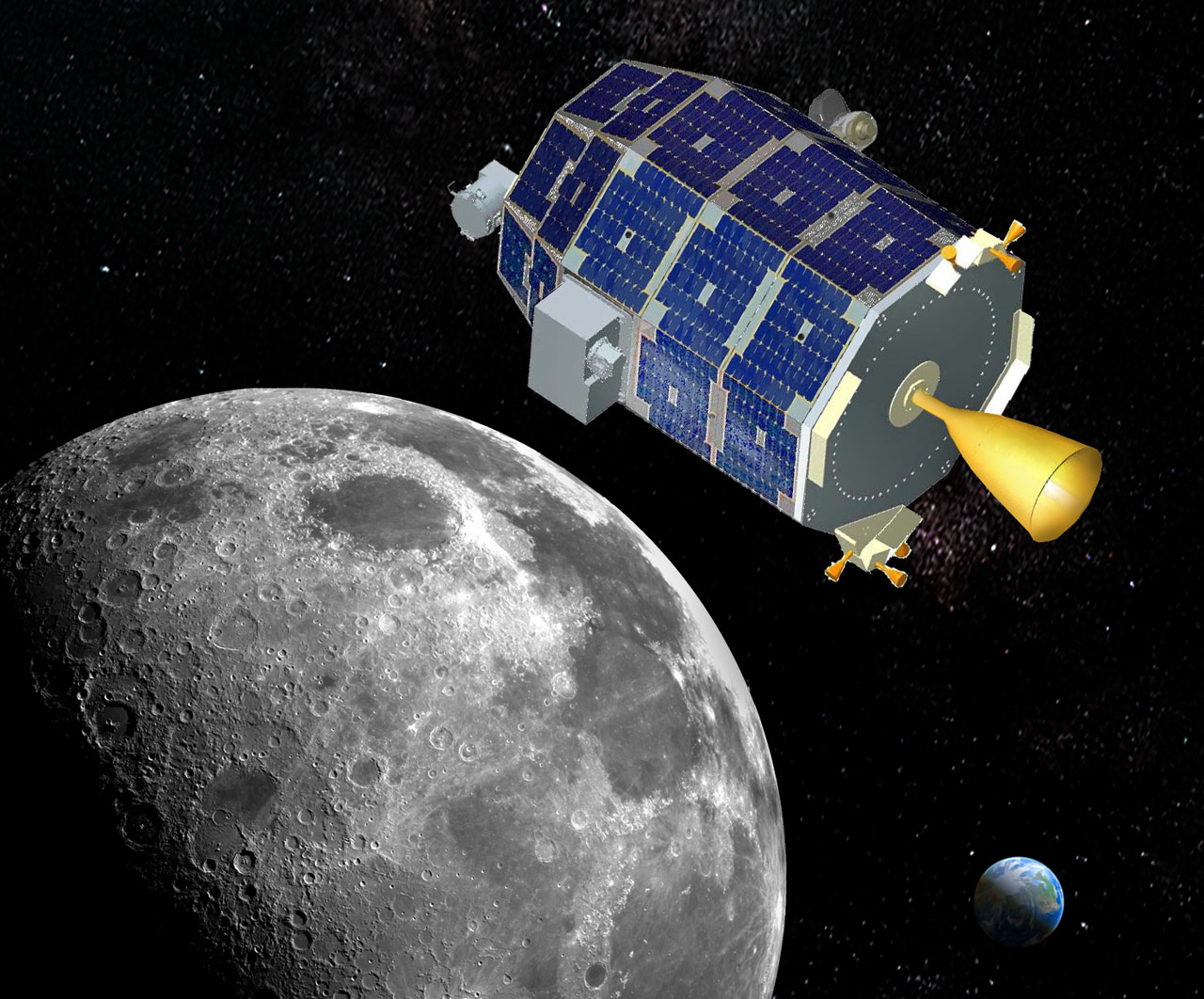
The launch of NASA’s LADEE moon probeladee (Lunar Atmosphere and Dust Environment Explorer) has several points of interest.  It was launched from the Wallops site, which made the flight visible from New York City.  A friend of mine photographed the streak of light it made across the sky.  It was sent up on a Minotaur V rocket, a derivative of the Peacekeeper ICBM.  Arms limitation treaties have meant that surplus ICBMs can be recycled into launch vehicles. And the probe will examine the moon’s atmosphere, which most of us were taught as children didn’t exist.  It does, but it’s very thin, more tenuous than the space just beyond the International Space Station.  Astronauts visiting the moon reported a diffuse glow on the horizon ahead of sunrise.  LADEE aims to find out if this is caused by electrically charged dust particles lifted up by the sun’s rays.  The probe is on a leisurely trajectory to the moon, and will ultimately settle into an orbit only 20km above the lunar surface.  After its 100 day mission, it will be made to crash onto the moon, and the dust plume kicked up will be studied by other instruments.

Intriguingly it will also be testing a laser communications system providing much faster data transmission rates of up to 600 megabits per second.  In further missions, especially those featuring human exploration, this promises to be an important improvement to the way we communicate from space.

Does technology destroy jobs or does it lead to the economic growth that produces more jobs?

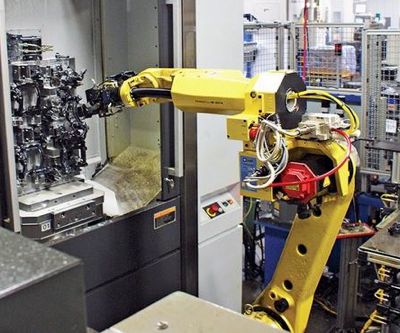
robot-armThe argument is as old as mechanization.  When machines were introduced into manufacturing, they lowered costs by making it possible for the same output to be produced by fewer workers.  From water frames to spinning jennies, the machines displaced labour.  Another way of looking at it was that technology made each worker more productive, and enabled them to produce more wealth, and that wealth made more jobs possible.  Those who followed Ned Ludd and smashed stocking frames, and the Dutch textile workers who threw their wooden sabots into the machines, clearly took the former view.

Robert D. Atkinson, president of the Information Technology & Innovation Foundation, makes a strong case for the second view, arguing that virtually all economic studies have shown that “the income-generating effects of new technologies have proved more powerful than the labor-displacing effects.”  It works like this because the increased productivity brings with it higher wages and profits or lower prices, or all three, and that extra wealth provides the demand that results in new job opportunities.

Higher technology can have an immediate effect of short-term job losses, but in the longer term it results in the economic growth that makes more jobs possible.  It will probably result in different types of jobs, in that service jobs are harder to mechanize, but a growing economy creates demand for things such as “more restaurant meals, vacations, cars, houses, therapeutic massages, college educations, and 3-D TVs.”  And people will be needed to produce these things.  Far from opposing new technology that makes each worker more productive, we should be embracing it.

True, the mechanical digger does away with the jobs of 12 men with shovels, but each of those shovels does away with the jobs of 100 men with teaspoons.  And the mechanical digger makes society more productive and wealthier, leading to jobs that pay better than those involving shovels or teaspoons.

Virgin Galactic’s SpaceShip2 test fires up to 69,000 feet


In this rear view video of the second powered flight of Burt Rutan’s SpaceShip2 we see the craft drop from its mothership, White Knight. The rocket is ignited and fired for about 20 seconds, and we hear the g-forces in the breathing and voices of the pilots. The top speed reached was Mach 1.43, and the craft coasts up to 69,000 feet (about 13 miles, well short of ‘space,’ but high enough for black sky and curved Earth’s horizon). The pilots correct small roll motions as it ascends unpowered. The twin tail booms fold out of sight as the feather system is engaged. We have a good view of the Earth below as the feathered descent takes place quite slowly. The booms are returned to their normal positions for the glide back to a runway landing at Mojave. The aim is to fly 6 paying passengers at a time just beyond the 100km nominal boundary for ‘space,’ and allow them to float in zero-g before beginning their re-entry.

Electric cars make news in the UK, and a cross-country trip in the USA is planned in the safest car

tesla_chargerThe UK government (like me) thinks that internal combustion engines will not be powering cars by 2050.  Already there’s a free tax disc and a £5,000 grant towards purchase.  Now new measures include a £10m competition to invent a long-life battery and more charging points in stations and car-parks, with a £500m package allocated to encouraging Ultra Low Emission Vehicle technology.

In the USA, the Tesla-S has been rated the safest-ever car in official tests. Even though it’s a sedan, it beat out SUVs and minivans. The reason is that without a large engine in the front, it has a longer crumple zone to absorb impacts.  The motor is about a foot in diameter and located near the rear axle.

We all hope that Elon Musk will suffer no accidents that test this ability when he embarks on his cross-country drive from Los Angeles to New York using a Model S and Tesla Superchargers.  He plans to cover the 3,200 miles in 6 days, with a total of 9 hours (1.5 per day) allocated to charging, doing that mostly when stopping to eat.  There are only 19 working Supercharger stations in the country, so he’ll need to have a few more completed and on-line before he and his family set out as promised before the end of the year.

Despite delays and difficulties with the Boeing 787 Dreamliner, Boeing presses on with two stretch versions of it

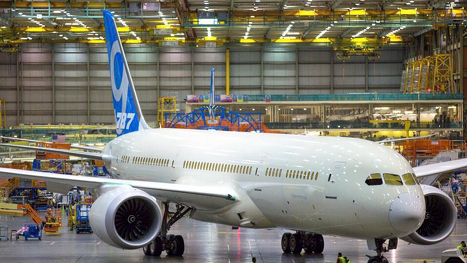
boeing 787-9Basically Airbus and Boeing made different bets. Airbus went for mass hub traffic with its A380 super-jumbo, whereas Boeing went for a fuel-efficient composite plane that could fly people point to point at lower costs.  Airbus hastily covered its bet by producing its own part-composite A350XWB. Now Boeing has unveiled its stretch version of the 787, the 787-9, which is 20 feet longer and with space for 40 more passengers, taking the total to 290.  It also increases the range by 300 miles, taking it to 8,500 miles. And at the Paris Air Show Boeing announced yet another stretch version, the 787-10, adding a further 18 feet and 40 more seats. The stretch versions use the same wings as the original Dreamliner, but strengthened to take the extra weight.

With the battery issues hopefully behind them, Boeing is doing what an aircraft manufacturer should do: exploit the technology the learning curve has supplied, and use it to develop profitable extra versions rapidly and comparatively cheaply. The best guess is that the 787 family will be a money-spinner for Boeing, whereas the future of the Airbus 380 looks less certain.  The tragedy of Concorde was that only 13 were built of the original version, and there never were the stretch and advanced versions that might just have paid off.  That tends to be what happens when countries instead of companies specify what planes shall be built.

Playing the scary numbers game with possible climate change migration

climate-floodSpeaking to the Institute for Public Policy Research, UK shadow immigration minister Chris Bryant warned that climate change could cause 200 million people to flee their countries (a BBC News Magazine story reports).  He quoted a UN estimate that 20m were displaced by climate change in 2008, and spoke of UN estimates that the figure might reach as high as  200m by 2050.

Alex Randall of Climate Outreach and Information Network doubts even the 20m figure which is, he says, reached by “adding up all of the people who’ve been displaced by any kind of natural disaster and labelling them climate refugees.” And many don’t migrate, he adds, but move short distances and then come back.  The 200m figure is based on research by Oxford’s Prof Norman Myers, whose 1995 and 2005 papers also predicted that 50m people would become climate refugees by 2010. It did not happen, of course.  Stephen Castles from Oxford University’s International Migration Institute has major problems with Myers’ methodology.

“He simply took a map of the world, worked out what areas would be inundated if the sea rose, say by 50cm, and then simply assumed that all the people affected by this sea level rise would have to migrate – and that a lot of them would migrate to developed countries. Really there was no basis for it.”

He does not deny there will be some climate refugees if Pacific islands are submerged, but puts the number at tens of thousands, not millions, and certainly not 200m. None of this will stop people like Chris Bryant playing the scary numbers game.  You pluck the most frightening number you can out of absurdly unlikely assumptions (often labelling it a “worst case” scenario).  This number plays around the NGOs and the media and is then quoted as if it had been established by serious scientific study.

Men have grown 4 inches taller in a century, but has anyone told architects, designers and furniture makers?

taller menNew research from Timothy Hatton, Professor of Economics at the University of Essex, shows that the average height of European men has grown in just over a century from 5ft 4in to 5ft 8in, an increase of 4 inches.  He compared figures from the 1870s to those for 1980.  More figures are available for men because they were measured for conscription.

The growth cannot be attributed to genetic section over such a short time-frame, and is being attributed to environmental factors such as better nutrition and rising health standards.  What happens to children in their early years is a big determinant of future height, and much-reduced infant mortality rates point to fewer people having their future height reduced by serious childhood diseases.  Similarly, good nutrition in their early years enables adults to grow taller than they might otherwise have managed.

I wonder if anyone has told architects to build houses with doorways larger than they were made a century ago?  I wonder similarly if chair manufacturers are placing their seats rather higher off the ground to allow for the extended legs that now sit down at them? Althought, Southern Motion furniture and the like, for example, match any requirement. Many people have taken increased width into account, but what about height?  I know that some car-makers have redesigned their seats to allow for the fact that many of their drivers and passengers are wider than they used to be, but I wonder if thought is being given by other designers to the implications of taller men?  It will be longer arms and legs as well as a greater overall height.  I guess it’s easier with bicycles because you just raise the seat (although you really need a larger frame), and easy with clothes because you just buy larger sizes – until you end up at High and Mighty.

A new opiate aims to deliver pain relief without giving the ‘high’ that fuels addiction

opium-poppyNatural opiates derived from the poppy plant and the synthetic opioids that resemble them are both valued for their powerful analgesic effects.  They also induce a euphoria that makes them highly addictive to some people.  Physicians would like a derivative that delivers the pain relief without boosting the dopamine pathways in the brain to deliver the drug’s ‘high’ that goes along with it and brings the problem of possible addiction.

Now Nektar Therapeutics has added a side chain to a morphine derivative that slows the rate at which it can affect the brain.  The result is a drug that gives good pain relief without the rush of instant pleasure that addicts find irresistible.  I myself have had heroin, but in my case it was called by its other name, diamorphine, and was administered in hospital.  I was not tempted to addiction.  A doctor friend told me that the brain’s response to the drug is different when it is administered to a patient in pain, as opposed to someone looking for kicks.  A drug that can relieve the pain without leading people to become addicted is an obvious benefit, and if Nektar’s new compound passes its safety tests, it might just provide that.