Posted on July 14, 2013 by Madsen Pirie
 Studies including the one in Oxford Ohio, have shown that people who are optimistic and look on the bright side of things can expect to live an average of seven and a half years longer than their more pessimistic counterparts. A BBC Horizon programme with Michael Mosley explored whether anything could be done about this. First they plotted Mosley’s left brain/right brain balance by seeing how fast he responded to dots shown behind faces, some happy, some sad. He came across as negative and pessimistic, with dominant right-side activity.
Mosley then practised 7 weeks combining meditation with cognitive bias modification (CBM). The meditation involved breathing exercises while allowing thoughts to drift in and out of consciousness, while the CBM had him picking out the smiley face in a group of blank or angry ones. After the 7 weeks a new test showed that Mosley had a much better left-right balance. He also reports he is sleeping better, worrying less about things, and is generally more optimistic. The statistics say he might have a longer, happier life.
I practise techniques to keep myself happy, but not meditation and CBM. I tend to avoid looking at things that will upset me or put unpleasant, hard-to-get-rid-of images into my memory. I avoid sad movies and novels, seeking out more uplifting ones in preference. I seek out the company of friends whenever I can. In general I try to think about things that will improve my life, and then set about making them happen. Rather than limiting my desires I try to make them happen. It seems to work. When I am asked for a word that describes me, I say “optimistic.”
____
The Horizon programme is available here for a time on BBC iPlayer.
To try the faces test go to tinyurl.com/lv5njmn
Filed under: Updates | 1 Comment »
Posted on July 13, 2013 by Madsen Pirie
 Levels of CO2 in the atmosphere seem to have been rising, though there is disagreement about what effects this might have. Some think the main cause is human industrial activity, some think that human agriculture has been a bigger factor, and some think it might be a natural change down to solar or cosmic radiation. Doom-mongers have painted vivid disaster stories of sea levels rising by several metres, of Artic ice all gone by 2050, and of the world baked to an arid desert. Most of these predictions seem to be exaggerated by people whose agenda is to make us all eschew the modern world with its fast-paced complexity and return to the measured rhythm of a simpler life. According to a study published in the journal US Geophysical Research Letters, something interesting does seem to be happening.
A new study, based on satellite observations, CSIRO, in collaboration with the Australian National University (ANU) reported that the rising levels of carbon dioxide have caused deserts to start greening and increased foliage cover by 11 percent from 1982-2010 across parts of the arid areas studied in Australia, North America, the Middle East and Africa.
The researchers took out other factors including rainfall, air temperatures, light intensity and land-use changes in order to study just the CO2 effects. We know that increased CO2 enables plants to photosynthesize more with less water, but this study is the first practical demonstration of large-scale effects on a global scale. Eleven percent is quite a large amount over a comparatively short period. It will be even more interesting if it turns out that the new foliage acts to slow the rise in CO2 levels by processing some of it into vegetation.
Filed under: Updates | 2 Comments »
Posted on July 12, 2013 by Madsen Pirie
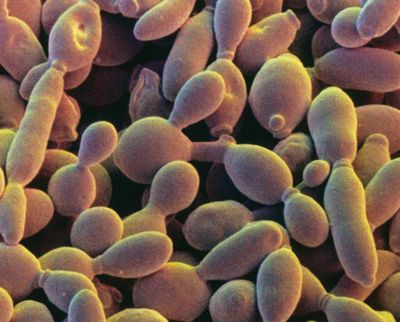
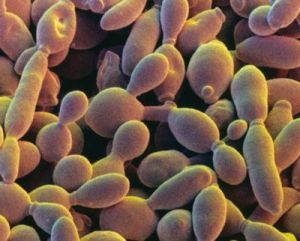 There’s nothing like taking on two big lobby groups simultaneously, which is what some scientists are about to do by creating a synthetic yeast. Yeast only has about 6,000 genes, making it simpler than larger life-forms. After a worldwide team synthesizes the 16 chromosomes needed, pieces of DNA will be designed on computers before being inserted into a yeast cell to replace its own DNA. The Telegraph reveals that this will enable stronger beers to be brewed by designing yeast strains to be more alcohol-resistant.
The anti-drink lobby will have a field day on this, since they have been campaigning for drinks to be weaker, not stronger. Environmentalists who have made money and attracted members by running groundless scare campaigns against genetically modified organisms will no doubt also howl with collective outrage at the creation of synthetic life-forms. The BBC story concentrates on the industrial applications there might be in making vaccines, biofuels and chemicals, but this is unlikely to mollify the critics. The government has put up nearly £1m to fund the research, so they will come in for some stick as well. The scientists might be well advised to keep quiet about the locations in which this research is to be carried out, since the mindless luddites have already shown they are quite prepared to use violence to stop research.
Filed under: Updates | 1 Comment »
Posted on July 11, 2013 by Madsen Pirie
 Hmm. We are told in a Telegraph article that “increasing numbers of families are mincing their own meat, baking bread and making their own chocolates as shoppers lose faith in the food industry.” It is alleged that the horsemeat scandal and the obesity crisis has sparked a boom in home cooking. The ‘evidence’ is that Lakeland kitchenware reported increased sales of mincing machines after horsemeat was found in minced beef or lamb. They also report a 300% rise in bread-making machines and a 220% jump in chocolate making kits, etc. Meanwhile Mintel’s market research reports increased sales of baking ingredients. So what does this amount to? For a time, following stories of incorrect food labelling, more people started mincing their own meat. How many more, and for how long? Following the successful BBC-TV series, “The Great British Bake Off,” more people took up baking. There’s an increase in home brewing, too, judging by the sale of kits.
Does this amount to a loss of faith in the food industry? Or maybe it’s the case that a temporary alarm caused a few people to be more careful, and a TV programme gave people the idea of developing new skills? Hey, I’m all for home cooking and do quite a lot of it myself. Writing a food blog for 5 years led me to become more ambitious. I enjoy doing it, and it’s usually tastier than stuff you can buy. As for home brewing, cherchez la tax. Duties on alcohol have made drinking out expensive, and the indoor smoking ban means that your friends who enjoy a cigarette or a cigar with their pint cannot join you. So you brew it at home and enjoy a cheaper glass among friends, with the added satisfaction that you made it yourself. I used to brew beer when I was an improverished student, and became reasonably good at it. At one stage I home brewed country wines from fruit and sugar, and in one case rose petals. They were nowhere near as good as the stuff made by established vintners, but it was cheap and I didn’t care. Are we looking at a little economizing in tight financial times, or a seismic shift in our habits caused by a “loss of faith in the food industry?” Your call.
Filed under: Updates | 2 Comments »
Posted on July 10, 2013 by Madsen Pirie
 It seems that some civil servants in the UK’s Department of Health are confused between the meaning of “servants” and “masters.” A little-noticed news report last week suggested that a ministry team was working on a proposal to force food manufacturers to spend a higher proportion of their advertising budgets on “healthy” foods – meaning those currently deemed healthy by the department. The department wants us all to live healthier lives, and will no doubt issue utterly meaningless statistics about how many lives “could be saved” if we all ate fewer crisps and more broccoli, and use that to justify forcing companies to do things against the interests of their shareholders. Part of the rot stems from the National Health Service, and not just from the way it covers up the fact that it has killed patients. What the NHS does is to give an excuse to the bully boys who want to force us to live a lifestyle of their choosing rather than ours. Because the NHS is funded out of taxation, they can claim that our choices cost taxpayers’ money. Thus if I eat crisps they can say that I will cost the public at large more money than if I ate broccoli. If we all funded our own health, insurance companies might put up the premiums of crisp-eaters and lower those of broccoli eaters, which would be fair enough. We would then face personally the costs of our choices, and could decide whether or not to accept them, and the bully boys would lose one of their main arguments. Somehow, deep down though, I just know they would find other excuses to boss us all around.
Filed under: Updates | 3 Comments »
Posted on July 9, 2013 by Madsen Pirie
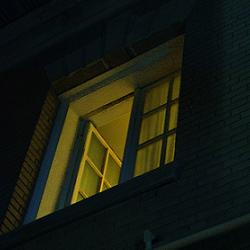 This could solve many problems. On hot nights you want the windows open to let the air in, but then you also let in those annoying noises that prevent you dropping off or which disturb your sleep. Two Korean technologists are reported to have come up with a solution. Sang-Hoon Kima at the Mokpo National Maritime University in South Korea and Seong-Hyun Lee at the Korea Institute of Machinery and Materials have developed a window that lets in one without the other. They’ve designed a sound resonance chamber using two parallel plates of transparent acrylic plastic about 150 millimetres square and separated by 40 millimetres, rather like double glazing. Kima and Lee drilled holes in the acrylic causing any sound that hits the chamber to diffract strongly into it.
They use their blocks, about the size of a paperback book, to create larger windows and report sound levels down by 20-35% over the range from 700 Hz to 2,200 Hz. The great thing is that the holes in their windows allow the air to flow through them, even while diminishing the sound. And they can tune the windows by varying the size of the holes so that some specific sounds can be screen out. They hope it will also work under water to tune out sounds that might harm marine animals.
Filed under: Updates | Leave a comment »
Posted on July 8, 2013 by Madsen Pirie
 A real treat about summers in Cambridge is the Cambridge Shakespeare Festival. Basically several of the colleges put on Shakespeare plays in their grounds for a month of open-air performances. The students work hard at rehearsal and props, and stage them in full costume. Upwards of 25,000 people attend, they tell us. It is complete magic to take along a picnic of smoked salmon sandwiches and champagne and sit on canvas chairs or on the grass and watch the play unfold. The treats this year include Romeo and Juliet in King’s, Richard III in St John’s and Hamlet in Trinity. I will certainly watch these, and possibly others.
Filed under: Updates | Leave a comment »
Posted on July 7, 2013 by Madsen Pirie
 A succession of hot sunny days has turned thoughts to outdoor cooking and the quality of the barbecue. I always use charcoal, preferably in briquettes, but some of my friends use gas. The gas ones are cleaner and easier to use, I admit. I line my bbq with aluminimn foil before packing the charcoal. That way when it is finished and has cooled, I can wrap up the ash neatly into the foil to throw away. It also protects the BBQ to some extent. Now there’s a report to back up what I have always supposed: that charcoal cooked food has more flavour. Gavin Sacks, a food science professor at Cornell, points out that we enjoy both tastes and aromas, and charcoal brings its different aromas to the food. In addition to the five tastes of sweet, sour, salty, bitter and umami, charcoal brings its aromas into the food, released when you bite into it. Their neurological signals mix with those of taste in your brain to give you the full package. And while gas has its aromas, charcoal-cooked food has guaiacol, whose smoky, spicy flavour is associated with bacon. It’s an aroma produced when heat breaks down lignin, the resin that binds the cellulose in wood, and its presence gives a smoky spiciness beyond what gas can offer (read more reviews from smokeyhousebbq.com). So scatter out those charcoal briquettes, pour on a good dollop of lighting fluid, wait until the white tips take hold on the charcoal, then have yourself some of that incomparable outdoor taste.
Filed under: Updates | 1 Comment »
Posted on July 6, 2013 by Madsen Pirie
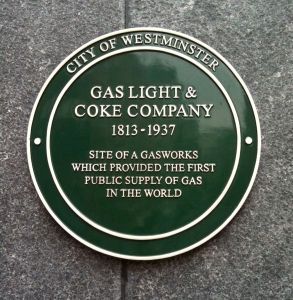 On the wall of the Home Office on the Great Peter Street side, just round the corner from the Adam Smith Institute, is a plaque marking the site of the Gas Light and Coke Company which once operated a plant there providing gas to light some of London’s streets. It started making gas in 1813, using coal brought in via Millbank to make coal gas and coke. It was the world’s first public gas works and must have made Westminster stink to high heaven! Over the course of its lifetime the company took over or amalgamated with many smaller gas companies. When electricity became available for lighting the company rapidly advanced into providing gas for domestic cooking, sending round “lady demonstrators” to show households the merits of cooking with gas. During both world wars many of the company’s coal ships were sunk by mines, submarines or enemy aircraft. In 1949 the company was incorporated into the nationalized UK gas industry, later privatized into British Gas. A vestige of it remains in the few gas street lights still operating in the Great College Street area. I have seen episodes of Sherlock Holmes being filmed there for the gaslit atmosphere, with chestnut sellers conveniently concealing the parking meters. And the site itself, stretching between Great Peter Street and Horseferry Road, is now mostly the Home Office.
Filed under: Updates | Leave a comment »
Posted on July 5, 2013 by Madsen Pirie
 Yesterday I stepped off the back of a 24 bus, something I had not done for many years. While I was away in the Galapagos Islands new buses were introduced on the 24 route between Hampstead and Piccadilly. They are inspired, as Mayor Boris Johnson tells us, by the old Routemaster buses which Londoners liked. A chief virtue was that you could step off the open back of the bus if it were caught in a traffic jam. The ‘door’ buses that replaced them had doors that the driver would not open except at a designated bus stop, making the passengers virtual prisoners. Many a time I have been late for a meeting because I was unable to leave a bus caught up in traffic. No doubt officials decided we’d all be safer that way. The new ones have three doors, front, middle and back, and you can enter and pay with your oyster card through any of them. There are stairs at front and back, too. Transport for London tells us that on busier central London routes a conductor will ride at the back, not collecting fares, but aiding passenger safety when people exit through the rear door. The conductor on my bus today was very courteous, informing me that if I did alight where there was no stop, I would do so at my own risk. I told him I knew that, and much appreciated being allowed to make my own decision about it.
Filed under: Updates | 1 Comment »





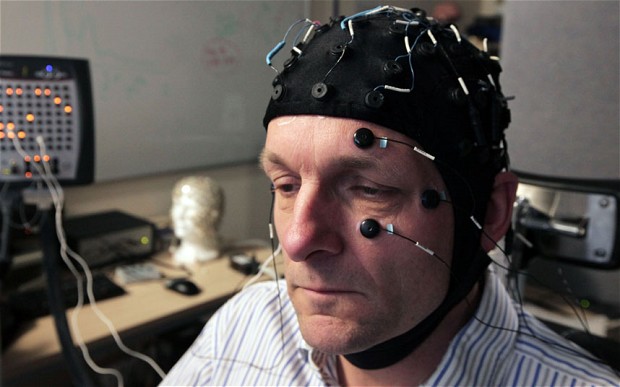 Studies including the one in Oxford Ohio, have shown that people who are optimistic and look on the bright side of things can expect to live an average of seven and a half years longer than their more pessimistic counterparts. A BBC Horizon programme with Michael Mosley explored whether anything could be done about this. First they plotted Mosley’s left brain/right brain balance by seeing how fast he responded to dots shown behind faces, some happy, some sad. He came across as negative and pessimistic, with dominant right-side activity.








 Madsen Pirie