Posted on June 23, 2013 by Madsen Pirie
The Mont Pelerin Society has chosen a magnificent setting to explore the philosophical connection between the work of Adam Smith and that of Charles Darwin. We walk along beaches lined with sea-lions resting in the shade of boats or sleeping on benches intended for humans. Then we go in to hear presentations on the theme.
Today we heard Prof David Kohn speak on “Adam Smith, Malthus and the creation of Darwin’s Theory of Evolution. The came Prof Diego Quiroga talking about “Darwin’s Islands.” This is turning out to be a real intellectual feast. I’ll post a link later to the papers.
Filed under: Updates | Leave a comment »
Posted on June 23, 2013 by Madsen Pirie
I’m spending a week at a Mont Pelerin Society conference in the Galapagos Islands. It might not be perfect for wifi access, but I’ll see what I can do. I came to Guayaquil first, then on to San Cristobal. The conference theme is on markets and evolution, both of which feature a selective death rate as part of the driving process. More of that later, and I’ll try to get some good photos of the wildlife to include. Bear with me.
Filed under: Updates | Leave a comment »
Posted on June 22, 2013 by Madsen Pirie
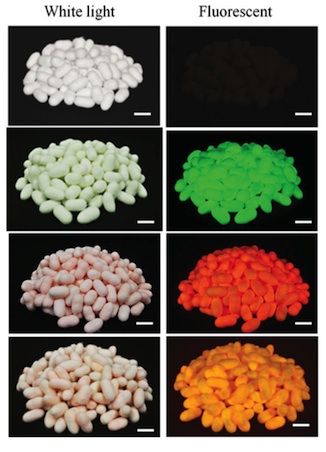
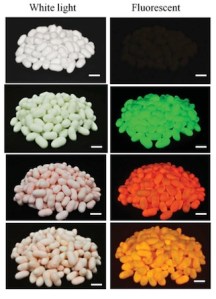 What could save on the process of colouring silk? The answer is to have the silkworms produce already-coloured thread. This has been done before by feeding them fluorescent dyes, but the new way involves genetically modifying the animals to incorporate genes for fluorescence. This means making the silkworms transgenic, incorporating genes from other species.
Creating the glowing silks meant borrowing from organisms that already produce fluorescent molecules. Scientists inserted the DNA sequences that produce these foreign fluorescent proteins into the silkworm genome, creating what’s called a transgenic animal. One batch got a red, glowing protein normally found in Discosoma corals; another got a glowing orange protein from the Fungia concinna coral. The third strain incorporated the green fluorescent protein derived from jellyfish.
As the silkworms spun, coloured threads were produced, and the colours stayed bright for over two years. It needed some new technology to prevent the manufacturing process from destroying the fluorescence, but they managed it. So now we can add fluorescent clothing to the list of things these talented little Bombyx mori have produced, a list that includes spider silk, human coillagen proteins and glowing proteins. Already the fluorescent silks have found their way into high fashion wedding dresses as well as everyday suits and ties. Hmm, I wonder if they do fluorescent silk bow ties. It could look rather cool…
Filed under: Updates | Leave a comment »
Posted on June 21, 2013 by Madsen Pirie
 NASA scientists are preparing to position the Cassini spacecraft so that it takes a photograph of Saturn with the Earth in the background. This will take place on July 19th 2013, when the probe will be about 898 million miles from Earth, nearly 10 times farther away than the Earth s from the sun. It will not be the first such photo. Cassini has been orbiting Saturn for nearly nine years, and in September 2006 it sent back the photograph shown above, in which the Earth is the white dot on the upper left, just beyond the bright rings. (Click on the photo to see it). Everything that happened on Earth from the dinosaurs to the whole of human history took place on that white dot. This will, however, be the first such photo we’ve had notice of, and the people at NASA humorously suggest that many of us should stop and wave as we have our picture taken.
Filed under: Updates | Leave a comment »
Posted on June 20, 2013 by Madsen Pirie
 This is a technology that seems to have crept up on me when I was not looking. I had not realized that electric planes had come this far. I still thought of them as being ultra-light, fragile, underpowered things, but this one even does aerobatics. It’s the E-Fan, produced by Didier Esteyne in collaboration with EADS, and its specifications are impressive. Unusually it uses ducted fan propulsion instead of the normal exposed propellers driven by electric motors. Cleverly there is a small additional electric motor in the landing gear that can let it taxi to 35 mph without using the main thrust engines. It has multi-cell lithium ion battery packs in each wing root, giving it about an hour’s flying time at 110 mph, but it is also designed to do loops and barrel rolls, and aerobatics halve its flying time. It’s still lightweight at 1,212 pounds, but this is undoubtedly a serious plane. I can’t wait to see this technology taken further, perhaps with a range of electric business aircraft. Serious it may be, but it still looks like it might be a great deal of fun to fly.
Filed under: Updates | Leave a comment »
Posted on June 19, 2013 by Madsen Pirie
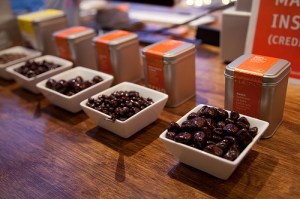 I’m always happy to post a story about new developments in chocolate, and this is a good one. Tcho chocolate can be found in places like Starbucks and Whole foods, and set out the taste characteristics of their produce with a pie chart to tell you which flavours to expect: chocolatey, bright, fruity, floral, earthy, and nutty. What’s really interesting is that Tcho doesn’t just go looking for sources of chocolate with the characteristics it want; it actually trains farmers in helping to develop them. It provides cacao farmers with coffee roasters, spice grinders, and modified hair dryers, plus customized groupware for sharing taster notes and samples with chocolate makers. Farmers learn to recognize the flavours in fermented, roasted and ground cacao beans, and what techniques can bring them up to the standards that Tcho and other buyers require. The process is complicated, but through it Tcho has achieved a quality control that many tasters think makes for better chocolate than the international mass producers manage to obtain. And producing more and better chocolate can never be a bad thing – the more so if it improves things for the cacao farmers in the process.
Filed under: Updates | Leave a comment »
Posted on June 18, 2013 by Madsen Pirie
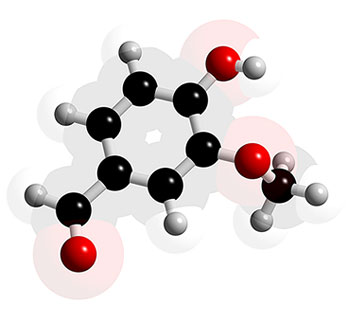
 The world seems to have an insatiable appetite for vanilla, some of it for the ‘white’ vanilla-flavoured ice-cream that everyone loves to eat on hot days. Unfortunately there are not enough vanilla pods to go round. We need maybe ten times as much as is being produced. There is a synthetic approach, making vanillin from the lignin in wood pulp, but the lignin has needed a mixture of sodium hydroxide and sodium sulphide to oxidize, both highly corrosive and requiring strong acids to neutralize the mixture. This is so environmentally unfriendly that it is rarely used. Ahmad Shamsuri and D K Abdullah at University Putra Malaysia have now announced a new method using 1,3-dimethylimidazolium methylsulphate, a room temperature liquid that is relatively benign. When the lignin is dissolved in this and oxygen bubbled through, vanillin can be filtered off. This offers a cheaper alternative to other ‘green’ but expensive ways of synthesizing vanillin, and holds out the prospect of changing the economics of its production. And of course to secure our future supplies of flavoured ice-cream.
Filed under: Updates | Leave a comment »
Posted on June 17, 2013 by Madsen Pirie
 There’s quite an interesting story about the use of genetically modified organisms by the Amish communities in the United States. The Amish are noted for the conservative lifestyle associated with their religious practices. They are not allowed to own or drive motor vehicles, so their horses and traps are a familiar sight in their areas, and electricity is not permitted in their homes. The movie “Witness” with Harrison Ford was largely set amongst an Amish community.
Their conservatism has not prevented them from embracing GM agriculture, however. Indeed, it helps them because their traditional methods are less productive than modern farming, and GM crops compensate them with increased yields. GM products allow more environmentally friendly agriculture by enabling them to avoid using pesticides and facing numerous side-effects (source: Round Up Lawsuit). Many Amish farmers grow a GM nicotine-free tobacco plant that fetches about ten times the cash per acre than conventional corn does. But some Amish farmers grow GM corn that has been modified to resist the caterpillar larvae of the corn borer pest.
The story is interesting because it compares with the resistance that has been whipped up against genetically modified organisms in the UK, for example. GM crops are used all over the world in countries such as the US, Canada and Argentina. They increase yields and they also enable less use of fertilizers and pesticides and the run-off pollution of rivers and lakes. No-one has been made ill by GM foods, yet the mindless campaign against them continues. Prince Charles is the most eminent member of that campaign, but he is just as wrong and misguided as the others.
Filed under: Updates | 1 Comment »
Posted on June 16, 2013 by Madsen Pirie
 Gene therapy has been used to operate on people with damaged retinas. It has involved using naturally occurring viruses to repair damaged light-sensing cells, but the problem was that it involved direct injection into the eye, a process that carries its own risk of damage by interfering with the eye’s photoreceptors. The new process involves selecting from random mutations induced in the laboratory the one most effective at taking the therapy to its target by itself.
The researchers produced millions of random variations of the adeno-associated virus, a harmless virus often used as a vector for gene therapy. From this vast pool, they ultimately identified the single strain that was the best at delivering new genes into damaged retinas.
They injected millions of viruses into the aqueous fluid of the eyes of retina-damaged mice. A subsequent examination of the retinas of the mice showed which strains had successfully made their way most effectively to the rodents’ retinas. Repeating the process led them to identify a single strain best at delivering the new genes where they were needed. They report that the virus carried its material across the retina, which “glued itself together” and saw its response to light restored.
It is still experimental. It works with monkeys, though not as effectively as with mice, so the team is working to locate a virus strain that will do a similar job in primates. The next step will be to try using the technique to restore sight to human patients.
Filed under: Updates | Leave a comment »
Posted on June 15, 2013 by Madsen Pirie
 This one is quite close to home. I live a short distance from Jesus Green in Cambridge, where a whole row of trees has taken on a ghostly white appearance. The culprits are caterpillars of the bird cherry ermine moth, one of the 2,400 species of moths in the British Isles. About an inch in length, the caterpillars protect themselves inside large silvery webs while they eat the trees’ leaves. They look rather like cobwebs can look in the early morning when covered in dew. While they do denude the trees of their leaves, the trees usually recover after the adult moths have left. The caterpillars will turn into pupae, and adult ermine moths will emerge in July and August. It looks as though a large number of birds will be very well fed during the summer, and the trees will gradually return to normal. Until then, however, we have an eerie white avenue to walk through.
Filed under: Updates | 1 Comment »















 Madsen Pirie