



• Adam Smith Institute

    Adam Smith Institute place holder
  • Philosophy & Logic

    Philosophy and Logic
  • Cambridge

    Cambridge
  • Children’s SF

    Children's Science Fiction
  • Enter your email address to follow this blog and receive notifications of new posts by email.

    Join 428 other subscribers

The private plans to send humans to Mars all seem to have some shortcomings, but they could easily be improved

peoplemarsNASA might not have a specific programme to land astronauts on the red planet, but private entrepreneurs certainly do.  Elon Musk has already sent his Dragon capsule to the International Space Station, and plans a larger one called Dragonrider to carry seven people into and possibly beyond earth orbit.  It could provide the vehicle for long distance voyages to carry humans across space to Mars.

Dennis Tito’s plan seems the most demanding on its crew.  He wants to use a Falcon rocket and SpaceX capsule to do a Mars fly-by, taking two people on a 501 day trip to brush within 100 miles of Mars and slingshot back to Earth.  That’s not very much living space for so long a trip!  And the trip itself seems rather pointless if no-one lands.

The way to make a Mars voyage more bearable might be to pick up one of Robert Bigelow’s inflatable units left in earth orbit to be collected, and docking with it to provide space to live in on the way there.

A little more imaginatively, it’s time we tested the use of a rotating spacecraft to simulate gravity on a long flight.  Two capsules separated by a narrow tunnel might do the job as they spun round each other.  And picking up extra fuel in orbit to go for a shorter trip would lower the risk of prolonged radiation exposure.  As I’ve said before, we should be using our imagination and thinking much more in terms of assembling vehicles in space, sending supplies and return vehicles to the surface of Mars and in orbit around it to await our arrival.  With enough ingenuity it can be made into a tolerable risk worth taking.

Learning to control devices by thought involves brain activity similar to what happens when we learn skills

mind-headsetFollowing my story about the helicopter controlled by thought, there’s new research about what happens in the brain when subjects learn to use these ‘mind machines.’  Scientists have found that the brain activity recorded when they do this is similar to that which takes place when subjects learn new motor skills.  The processing resembles that which happens when people learn to play the piano or to ride a bicycle.  The difference is that there is no direct feedback into the brain as there is when tasks like these are attempted.  In its place there is feedback from observing what happens to the object the mind is attempting to control.

The experimental thought-controlled helicopter is the latest in a long line of devices, some of which are designed to assist people with disabilities.  Some venture into more exotic areas, however.  Samsung, for example, is reported to be working on a ‘mind control’ tablet device.  And I can imagine applications to new types of computer game in which players control their real-world avatars with their minds.  That sounds as though it might be a lot of fun.  I rather think that this technology is going places.  As we reach the stage of being able to control our computers with voice commands in place of keyboard, mouse and touch-screen, the obvious next step will be to have devices we can instruct just by thinking what we want them to do.

A cloaking device hides a cat and a fish, but it can’t yet hide the cloak

cloak-fishThe device, like most cloaking devices works by bending light waves around an object so the background can be seen, but not the object in front of it.  In the first movie a cat enters the box and cannot be seen against the background, and in the second a fish swims upward, concealed while it is behind the device, even though the plants behind it can be seen.  The teams in China and Singapore did not use meta-materials, but a type of ordinary glass that bends and disperses light.

First, the team placed six thin pieces of glass inside a hollow, transparent hexagonal chamber. The result is a device with six-fold radial symmetry that will cloak an object from six different directions… Next, the team built a larger version of the device that could hide a cat. Unlike the hexagonal device, this cloak only shields an object from viewers directly in front of or behind it, as evidenced by bits of the curious cat disappearing while inside.

It’s not ready for James Bond yet because it only works from one viewing angle, and because the device itself can be seen by its shadows and joins.  But it’s yet another step in the direction of the Harry Potter invisibility cloak or the Romulan cloaking device from the Star Trek series.  The scientists suggest that the device could eventually lead to “important security, entertainment, and surveillance applications.”  Indeed yes, and it might have battlefield implications to hide tanks and guns.  It’s going to be harder to hide drones, but you can bet that some team out there is already working on that.  I remember the sensation when Kelly Johnson’s Skunk Works came up with the stealth technology that led to the F117A Nighthawk.  No doubt some troops in some future conflict are in for a similar surprise.

Talented teenagers strike again, with low-cost self-driving cars, rapid charge batteries, and galaxy cluster simulations

isef-2013-winners-masthead-3x1.jpg.rendition.cq5dam.webintel.960.320As you gather, I really like it when young people manage to achieve worthwhile discoveries and inventions.  This time it’s the Intel International Science and Engineering Fair.  They announced the top winners of their high school science research competition. Ionut Budisteanu, 19, of Romania won $75,000 for using artificial intelligence to create a viable model for a low-cost, self-driving car.  Second was Eesha Khare, 18, of Saratoga, Ca., winning $50,000, who developed a super-capacitor that can charge a mobile phone within 20-30 seconds, and has potential applications for the batteries of electric vehicles.  Third was Henry Lin, 17, of Shreveport, La., who also won $50,000. By simulating thousands of clusters of galaxies, Henry has provided scientists with valuable new data.  Hats off to Intel for promoting such an imaginative competition, and hats off to the 1,600 kids who were chosen to take part, and to the schools, teachers and parents who encouraged them.  Tomorrow’s world will offer more choices and more chances to enrich the lives of more people, and it’s youngsters like these who will help bring it about.

Controlling things with the mind takes a step nearer with a thought-guided helicopter

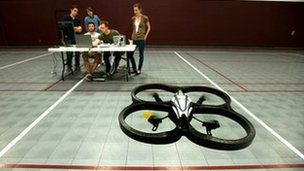
thought-copterIt’s been the stuff of science fiction movies for some time.  The hero (or villain) dons a special cap and is able to control physical objects using brain waves.  Outside of science fiction I remember many years ago seeing a demonstration house in which the owner could turn lights on and off just by thinking the thought (after the user and the switch had been trained).  Now there’s a thought-guided model helicopter. Professor Bin He, director of the University of Minnesota’s Institute for Engineering in Medicine, has written up their research in the Journal of Neural Engineering, describing how participants were able to steer a model helicopter with high accuracy.

“For the current work, five participants were selected to wear a simple “cap” that held 64 electrodes, using it to “teach” the computer the brain patterns corresponding to thoughts of movement – clenching of the left and right fist for turning left and right, clenching both fists to go up, and doing nothing to go down.  Then the computer was set up to run the helicopter over wi-fi, with only the participant’s thoughts at the controls.  The copter was made to reliably fly through an obstacle course in the university’s gymnasium – participants’ success rates were as high as 90% in obstacle avoidance.”

There are obvious implications in developing this further.  Disabled patients might be able to steer a wheelchair by thought power.  Further down the line a prosthetic limb might be moved by the thoughts of its wearer.

It’s a field I’ve long been interested in.  In the golden age of science fiction many writers would assume that some of us would develop or be developed with special mental powers enabling us to communicate mentally or to move objects.  I always thought that science might actually achieve similar results by way of machine-augmented action controlled by thought waves.  A tiny phone inserted under the skin and controlled by thought might enable us to communicate wordlessly to someone wearing a similar device.  Similarly, instead of using mental power to turn the wheels, we might use mental power to control the motor that turns the wheels.  It would not actually be telepathy and telekinesis, but the results would look pretty similar.

After Earth is an entertaining movie, but Jaden Smith, rather than Will, is the star

Jaden-SmithAfter Earth was rather panned by the critics in both the US and the UK, though first day audiences rated it “satisfactory.”  I saw a trailer and went to see the movie on the strength of it.  The critics were too harsh, in that I found it to be quite entertaining.  It had two main virtues: none of it was boring and none of it was silly.  The basic plot is that when they crash onto an Earth long abandoned to hostile life-forms, the ranger commander’s 14 year-old son has to undertake a hazardous trek to locate and activate a distress beacon that will bring rescue for himself and his injured father.

No scene goes on too long, and the excitement is kept ratcheted up as young Jaden encounters and escapes the various dangers en route, with his injured dad  following his progress on a com-link.  I thought the special effects and CGI quite plausible, and didn’t detect any fake scenery.  It was easy to suspend disbelief and get absorbed by the story.  After Earth isn’t really an actor’s movie, but there were none of the rather wooden performances that tend to feature in action movies.  Jaden is actually quite a good actor and is on camera most of the time, with his movie and real-life father Will Smith in a mostly sedentary supporting role.  I rated it quite good and well worth seeing, but this might be because I’m a science fiction fan and write some of it myself.

What IQ measures and why a high IQ is not “genius level.”

einsteinIt’s a remake of a familiar story that surfaces periodically.  This time it’s Neha Ramu, a 13 year-old who has joined Mensa with an IQ score of 162.  It is not, as the BBC tells us, “a perfect score.”  Nor is it true that “a score above 140 is considered to be that of a genius.”  During the 13 years when I was Secretary of Mensa similar stories cropped up every few years.  The society publicized them to help boost applications and membership.  The level required for admission into Mensa is the top 2 percent of IQ scores.  In Britain that would cover more than a million people, so it is not all that exclusive.  Some years ago I co-authored three books on IQ with my colleague Dr Eamonn Butler, and we even devised and standardized a new IQ test to accompany them.

Mensa normally uses the Cattell III B or occasionally the Cattell III A culture fair tests.  A score above 148 on Cattell III B is required for admission into Mensa.  To put it into perspective, I live in Cambridge, where most of the students would score at or above that level.  The test has different sections, one dealing with numbers, one with words, one with diagrams and one with situational logic.  The aim is to minimize the degree to which someone not very adept at one of those categories will score below their worth.  What IQ measures is your ability to pass an IQ test.  There is a correlation with reasoning ability and mental agility, but the IQ score is only a rough proxy for these qualities.  Most tests are biased because our culture is WEIRD – Western, Educated, Industrialized, Rich and Developed, and most of us have grown up against that cultural background.

It seems that IQ has both inherited and environmental components, and the recorded steady rise in average IQ scores probably reflects the fact that the environmental component is being increasingly developed to more of its potential.  The average IQ score was set at 100 when IQ tests were first devised, though it is higher than that now in some countries.  Neha’s parents are both eye doctors, so we can safely guess that the inherited and environmental components of her IQ are both high.  This is not “genius level,” though, and it will do her no favours if the press compares her with Albert Einstein and Stephen Hawking.  Genius is something different, and involves a lot more than a high IQ score.  It usually involves great insight and creativity as well.  However, when people ask me if they should take the Mensa test and have their IQ measured, I usually say yes.  If you know you have a high IQ it might give you the confidence to attempt more ambitious targets in life.

Step forward the earliest primate – it’s the Archicebus, whose fossil was found in China

fossil primateThe dinosaurs held sway for over 250 million years until an asteroid or comet came along 65 million years ago and wiped them out (and scattered an iridium layer between our rock strata).  To put this in perspective, reflect that humans have only been around for about 3 million years.  Only ten million years after the cosmic catastrophe that killed the dinosaurs, this little fellow came along.  His remains have been revealed in a Chinese fossil.  He’s about the size of a mouse, but he’s a primate – the earliest one ever discovered.  The name Archicebus approximates to “little monkey,” and he has several monkey-like features.

china primate“Particular features of Archicebus’ skeleton suggest it would have used a leap-and-grasp motion as it traversed through these great forests.  Its small pointy teeth indicate that it ate insects. Certainly, its size would have meant it had a high metabolic rate, and preying on insects would have satisfied its calorie needs.  And the creature’s relatively large eye sockets suggest it had good vision for hunting, although the team says the evidence points towards Archicebus being a daytime operator, not a nocturnal animal.  One of the most significant observations is the shape of its heel bone. Far from being like a tarsier’s calcaneus, the bone is more reminiscent of what one would expect in an anthropoid.”

It’s thought that the creature is a very early ancestor of the tarsiers, and probably emerged very soon after that group diverged from the anthropods, the group that eventually gave rise to monkeys, apes and humans.  It gives us a fascinating look into how primates first evolved in the lush steaming jungles of the post-dinosaur earth.  And as we see from the artist’s reconstruction, it’s also pretty cute.  If these creatures were around today, they would probably be very popular as pets.

A good cava is far superior to a cheap champagne

Cava corkI usually serve vintage cava at parties in preference to some of the lower priced champagnes.  I actually think that the house champagnes from Sainsbury’s and Tesco are quite good value, but to my taste are not as good as a vintage cava that might sell for a much lower price.  Cava is the most popular Spanish sparkling wine.  Most of it is produced in the Penedès area of Catalonia from the macabeu, parellada and xarel-lo grapes.  It is made by the methode traditionelle in the same way as champagne.  When Josep Raventós visited France in the 1860s he took a liking to champagne and decided to produce a Spanish equivalent.  When the phylloxera plague destroyed many of Catalonia’s red grape varieties, they were replaced by the white ones from which sparkling wines could be made.

The Telegraph’s Victoria Moore has discovered the merits of cava and praises it in one of her columns, but I have long been an enthusiast.  The two best-known labels in the UK are probably Codorniu and Freixenet, both quite acceptable.  I find vintage cava is far more to my taste than non-vintage, though it is more expensive.  My solution is to buy it when supermarkets have it on offer at half price, so I pay £6 – £6.50 per bottle rather than the £11.99 it usually sells for.  I often lay in a few cases at a time.  Among the labels I like is Marques de Monistrol, and if it’s not available at a reduced price I sometimes buy Codorniu 1551 vintage cava instead.  A good vintage cava should be crisp yet creamy, and have a characteristic ‘biscuity’ taste.  And lots of fizz, of course, in small bubbles.

Madame Bollinger had the best words on when to drink champagne, declaring, “I drink it when I’m happy and when I’m sad. Sometimes I drink it when I’m alone. When I have company I consider it obligatory. I trifle with it if I’m not hungry and drink it when I am. Otherwise I never touch it – unless I’m thirsty.”  I think the same could be said for vintage cava.

UK students exercise freedom of choice and more of them head for top US universities

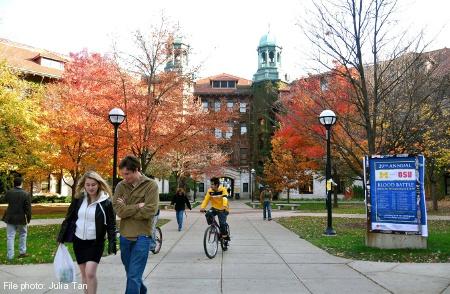
US CollegesUS universities used to be thought too costly for all but the wealthiest British students, but things have changed.  With UK university fees now hitting £9,000 a year, and with US institutions competing with scholarships to attract top talent, more Brits than ever before are heading westward over the Atlantic for their education.  Graeme Paton, Education Editor at the Telegraph reports that nearly 10,000 UK students took US courses in 2011-2012, and expects the numbers to be even higher this year.  Undoubtedly one of the attractions is the breadth of the liberal arts curriculum in the US, with students allowed to take many more subjects than their UK counterparts to include in their degree.  Another is the reputation of top US universities, with most Ivy League colleges reporting big increases in student numbers from the UK.

A further factor is the attempt by the UK government to pressurize universities here into social engineering, leading them to take less qualified state school students ahead of privately educated ones with higher qualifications.  Rather than be pushed into a less prestigious university, increasing numbers are turning their attention instead to US ones with worldwide reputations.  The head of Bedales School reports that one in twenty students now go abroad, and predicts it will rise within five years to one in ten.

I am often asked by sixth-formers for advice and help with university admissions, and I routinely suggest they include at least one prestigious US institution as a ‘banker,’ in case they fail to gain an admissions offer from a UK one of sufficient quality.  A student who fails to be admitted to Oxford, Cambridge or London, has the option of obtaining a no less prestigious degree from Harvard, Yale, Princeton, MIT and the others.  This trend, accelerated as it has been by the actions of UK governments, is actually a good thing.   It is great that British students have access to more choices than those available in the UK.  It is also good that they can choose to study a broader curriculum, and it is good that they can gain a perspective outside of what they could experience in their own country.  Globalization in education is no less good than globalization in the rest of the economy.