


• Adam Smith Institute

    Adam Smith Institute place holder
  • Philosophy & Logic

    Philosophy and Logic
  • Cambridge

    Cambridge
  • Children’s SF

    Children's Science Fiction
  • Enter your email address to follow this blog and receive notifications of new posts by email.

    Join 428 other subscribers

A teenager who builds a working one-person submarine – while keeping up with his homework

teen subHis name is Justin Beckerman, aged 18, and he’s just built himself a one-person submarine for less than $2,000.  He assembled it in his spare time using a fair amount of scavenged odds and ends.  His sub has ballast tanks, and can submerge with its pilot to a depth of 30 feet, remain submerged for up to 2 hours, and travel underwater at up to one and a half miles an hour.  He’s been making things like this since he was 2, his mother tells us, and his own website shows a remarkable collection of the things he’s built.  His submarine, named Nautilus, has a regulator and pressure gauges from a defunct soda siphon, and its batteries are recycled from a child’s toy.  He intends to use it to explore the bed of his local lake.

This is an excellent can-do story from a world in which if you want to do something you go ahead and tackle it.  It’s the same world inhabited by Jack Andraka, the teenager who won the youth achievement Smithsonian American Ingenuity Award for inventing a faster, cheaper way of detecting pancreatic cancer much earlier.  I love this world and wished more people lived in it.  What I like about it is the way in which its inhabitants see difficulties and barriers only as problems to be overcome.  If you want to do something you systematically set about the steps and stages required to achieve it, and you don’t listen to people who tell you it can’t be done.  And sometimes you achieve something remarkable.

Tesla rolls out the charging infrastructure for electric cars

tesla-superchargerTesla’s boss Elon Musk has announced a major acceleration of its rollout of charging stations.  Its Supercharger stations already serve large chunks of the West and East coasts, with facilities covering California and Nevada in the West, and from DC to Boston in the East.  Now the plan is a network of cross country stations that will offer a fast charge in 20-30 minutes to give another 200 miles of driving time.  The recent demise of Better Place suggests that fast charging will beat battery replacement as the main way of solving the electric car’s limited range problem.

Tesla has already solved the image problem of electric cars.  Whatever their efficiency might be in terms of costs per mile, they were perceived as boring, being mostly small family saloons fitted with lots of batteries and underpowered.  Tesla’s range are head-turners with impressive performance statistics.

Elon Musk is taking a bold step in the spirit of American invention, by providing the infrastructure and using its availability to boost demand.  This is what happened to electric lighting and early telephones.  Once the network was in place, at both cost and risk, along came the customers.  With luck, he’ll have guessed right.  The future of the automobile is probably electric in the near future, using electricity from gas-fuelled power stations, although intriguingly Musk plans to use solar power for many of his cross country Superchargers.  Cost projections suggest that photovoltaic power might be competing with gas on cost in the quite near future.  This is all quite exciting, and set to become more so once Google does the driving for us so we can concentrate on more interesting things as we head on our way.

Voyaging to Mars quickly in order to minimize exposure to damaging radiation in space

people-on-marsBBC News regularly featured the story that any spacefarers headed for Mars will face radiation that is over the acceptability limits NASA tries to keep its astronauts within.  The robot Curiosity on its long voyage to the red planet monitored radiation from two principal sources.  One was that emitted by the sun, and the other was the stream of much higher energy particles coming in from deep space that are the legacy of cosmic collisions and supernovae.  The latter are much more damaging, and are the source of the light blips that affect the eyes of astronauts even when closed.  It is the long voyage that builds up the unacceptable levels.  Once on Mars the atmosphere provides some protection.

Shielding has been suggested, but it would need to be very thick to afford appreciable protection, and would greatly increase the mass that had to be accelerated.  The other is a shorter journey time, cutting six months down to a few weeks, and people have suggested waiting for higher technology propulsion such as ion drives and plasma engines.  A simpler route to a shorter trip might be to burn more fuel with conventional engines, but that in turn would raise the vehicle’s mass.

The solution might be modular construction of a craft in low Earth orbit, with sections being lifted off separately and assembled in space before departure towards Mars.  This would mean that extra fuel for a faster velocity could be achieved with additional launches.  It is rather surprising that none of the outline plans call for material to be sent to Mars ahead of the astronauts.  The technology that landed Curiosity could send ahead supplies and equipment, and even the ascent vehicle for Mars lift-off, and the return craft waiting in Mars orbit to bring the crew home.  Then the outward voyage could be a high-velocity one in a relatively light craft whose function was simply to get the crew there quickly before they were exposed to damagingly high levels of radiation.

Feathers fly in the case of the dawn bird dinosaur

aurornisIt is reported to be 160 million years old, with the impressions of its feathers in the shale slab that contains its fossilized skeleton.  The scientists have called it Aurornis, or dawn bird.  Its significance is that it gives us insight into the stages by which birds emerged from the dinosaur lineage.  It restores the most famous feathered fossil, archaeopteryx, to its status as an ancestor of modern birds.  The primitive features of the Aurornis put it right at the point where avialans began, about 10m years earlier than archaeopteryx, which could certainly fly.

The find is not without controversy, though.  It was found in Liaoning province, and handed in by farmers.  Some fossils have in the past been found to have been ‘enhanced’ or faked, so the question of authenticity has been raised.  Experts who have examined it rate the likelihood of fraud as very low, so it does seem to be a major discovery, adding to the roughly 30 species of feathered dinosaurs mostly discovered in the same region.  But this one is the oldest yet, and gives us vital clues as to how and when birds first developed.  And inside some modern birds might be part of the DNA of the dinosaurs in their distant past.

A new threat emerges to the UK’s renewable energy sources

coal-powerA surprise threat to the UK’s chances of meeting its targets for renewable energy sources has emerged.  The UK subsidizes some renewables directly through government grants, and some indirectly by forcing consumers to pay more on their energy bills.  Several renewables are pursued simultaneously, including wind power, solar power, wave power and biofuels.  Now the Chairman of the Environment Agency, Lord Smith has identified a new threat – coal.  That is correct, coal, and cheap coal at that.  The point is that the price of coal has been falling on world markets, falling to such an extent that coal-produced power is now among the cheaper options.  Unfortunately it is also one of the most, if not the most, polluting option, putting out lots of CO2 and other noxious gases and particulates, plus (for certain types of coal) lots of suplhur.

Why is coal so cheap, even though the Chinese are building one new power station a week that uses it, and plan to continue doing so for at least a decade?  The answer is gas, our new friend shale gas produced by fracturing technology (fracking) principally in the United States so far, but soon to become more widespread.  Shale gas is so cheap that people prefer it for their power stations, reducing the demand and the price of coal.  Is pollutes less than half as much as coal and helps countries reduce their emissions without relying on the much more expensive renewables.  Lord Smith wants the UK to develop its own reserves of shale gas, but with a proviso that power stations using it capture and store their CO2 emissions.  This is fair enough.  The immediate energy future is gas, cleaner, easier to transport and easier to use than coal.  There is no economic case for wind power, and precious little if any environmental case.  Biofuels using food crops make no sense at all.  Wave power is expensive and limited.  But solar power, meaning photovoltaic power, is coming down in price very rapidly and stands ready to take over from gas in the future.  The UK might lack the sunshine to make full use of it, but we can buy power from those who can.  Until then, however, it is gas.

Finding ice beneath the surface of Mars – what the Phoenix mission achieved

Phoenix- landerThere’s a timely review of the achievements of the Phoenix Mars lander five years after it touched down on the red planet.  Dr Tom Pike of Imperial College, London, and one of the mission team, reports on some of the findings the robotic spacecraft accomplished.  It touched down in the polar region, unlike other landers, and used a mechanical arm to dig down below the surface.  Photographs showed sub-surface ice revealed, ice that was seen to melt away.

ice-on-marsCrucially the probe also revealed the presence of significant quantities of percholorates in the Martian soil, a finding later confirmed by the Curiosity mission.  Since these chemicals are very soluble, it indicates that there has been no major surface water on Mars for a long period of time.  This in turn suggests that if we do find life on Mars it might not be on the surface but beneath it.

Phoenix also enabled us for the first time to see snow falling on Mars, and it looks from orbit as though it might have been a winter snowfall that finally snapped its solar panels and stopped it working as the Martian winter set in.  Dr Pike’s work goes on, however, and we must wish him well on the next Mars mission, Insight, that he’s involved in, scheduled for a launch in 2016.

Science solves the great problem of how to put cream and jam onto the perfect scone

scones:jam:creamFor generations the question of how to prepare the perfect scone for cream teas has led to disagreements, especially between the English counties of Devon and Cornwall where scones are traditional.  In Devon they put the cream on first and then the jam, whereas in Cornwall the jam is applied first, then cream on top.  No less dispute has raged over the pronunciation.  The word derives from the Scots Gaelic word ‘sgonn,’ meaning ‘cake’ and pronounced to rhyme with ‘gone.’  However, some English people think from the spelling of the modern word that it ought to rhyme with ‘cone.’  Another issue concerns how thick the scone should be.  A colleague of mine used to cut scones into three slices, claiming that this way he could eat more cream and more jam with them.  Science has now provided possible answers.  The research was commissioned by Rodda’s Cornish Clotted Cream, so discount possible bias.

Dr Eugenia Cheng now claims to have the final word with a mathematical formula which is a victory for the Cornish.  Dr Cheng, a senior lecturer who often uses food to explain complicated maths, broke down the cream tea into its three key elements: scones, cream, and jam.  The resulting formula suggested ratio of 2:1:1 (by weight) – so the average scone, weighing 70g, would require 35g of jam and 35g of cream.  She concluded that clotted cream is better than whipped cream, because of the excessive volume size of whipped cream required.  The total thickness of the scone, with all its elements, should be around 2.8cm, to allow it to fit in your mouth easily.  Jam, due to its density, needs to be first as the cream could cause the jam to run off.

They serve really scrumptious scones with clotted cream and jam at the Old Bridge Hotel in Huntingdon, where I often used to eat them sitting outside next to the river on sunny afternoons.  I ate them (and still do occasionally) sliced in half, with each half spread the Cornish way with clotted cream on top of the jam, and eating each half separately.  Mmmm.

Does food, and especially seafood, taste better on holiday?

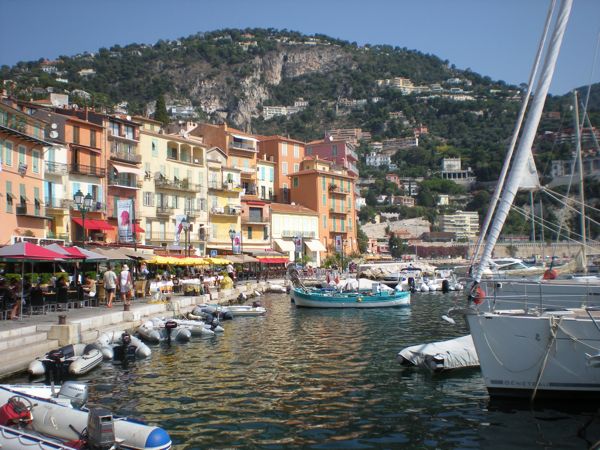
villef-portMany say that food does taste better when you’re overlooking somewhere nice and in a relaxed holiday mood.  They are borne out by food science, which points out how large a proportion of our enjoyment goes beyond the actual taste.  Colour, presentation and smell play their part, as does expectation, as does its setting.  This is why those Mediterranean scallops eaten with a glass of Provence rosé are never as good when you try to replicate the dish at home. Part of the reason could also be that the seafood you eat at coastal resorts is usually fresher.  I once ordered fish and chips at a harbour-side café at Crail, in Fife.  When it came 20 minutes later, the proprietor apologized that she had been delayed by the queue at the boat where she’d gone to buy the fish.  It was indeed fresh.  Bee Wilson in the Telegraph makes a similar point.

Elizabeth David writes about the difference between ‘town fish’, which needs embellishments such as melted butter and sauces, and fish that ‘has such a marvellous flavour of the sea that it is absurd to serve any sauce with it’.  Near the sea, the salt in the air seems to work its way on to your palate, making you crave seafood. Years ago on honeymoon in Piran in Slovenia, my husband and I found ourselves eating seafood risotto twice a day. All the waterfront restaurants did a version, and it never disappointed: soupy with sweet rings of squid and mussels. With a carafe of white wine and a view of the Adriatic, we didn’t want anything else.

scallobsterWhen I visit Nice in the South of France I often eat overlooking the sunlit bright blue waters of the Mediterranean.  This is especially true in Villefranche, just along the coast.  I often eat outside at Les Corsaires (at the very left of my top photo).  The scallops are presented in a cream sauce and arranged on a black slate to look like the segments of a lobster.  With rosé wine from the regions vineyards, they do taste far better than any I can obtain in the UK.  And yes, the setting is part of that…

Using liquefied air to store electrical energy

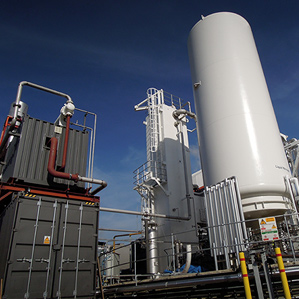
liquid.air

The idea of using something to act as an energy store is by no means new.  I remember a power plant in Wales that used off-peak electricity to pump water uphill at night so it could be released to generate power when it was needed during the day.  The process is not very efficient, in that it generates less electricity coming out that it uses going in.  Typically it might exceed 50 percent, but be nowhere near the 90 percent a battery can deliver.

Now there’s a new idea that involves using liquid air.  It’s reported that Highview Power Storage of London is developing a system that uses liquid air.  The idea is that electricity is used to cool air down to the nearly -200 degrees C needed to liquefy it.  The air can then be allowed to warm and drive a generator when the power is needed.  At the moment they claim 50 – 60 percent efficiency, but no doubt that can be improved by fine-tuning the engineering.  And waste heat from other industrial processes can be used to heat up the liquid air.  Part of the attraction is that instead of using fossil fuel plants to back up renewable energy power sources when they are not generating, it is possible that storage plants such as this could be used instead.

A fun new jet that can take off and land using rough runways

pilatus PC24The Swiss company Pilatus has unveiled a new and rather versatile jet that does not require conventional long paved runways.  Reports say their PC-24 will have a maximum cruising speed of 489mph, a top range of nearly 2,000 miles, and able to carry 6 to 8 passengers.  A special feature is a very large cargo door, and the plane will be able to use dirt runways thanks to the high positioning of its twin jets well clear of any debris thrown up from below.  Take-off will require less than 3,000 feet, and landing only 2,500 feet.  It ought to be popular as a business jet because of its ability to use shorter conventional runways than its rival, and it might see use as an air ambulance, given its big cargo door and its ability to land in rough places.

Small jets are becoming quite fun, with new models in the ‘very light jet’ category coming out every year, and with the kind of versatility the PC24 incorporates.  I have taken off from grass runways, including a flight from Duxford in a de havilland Rapide, a 1930s twin-engine biplane.  You can still book pleasure flights in one.  The take-off is bumpier from grass than it is from concrete, but it’s quite fun, as the new jet promises to be.  I’ll certainly take a trip in one if the opportunity presents itself.