

Interviewed by Andrew Neil, I gave a robust defence of what capitalism has achieved.
Filed under: Updates | 1 Comment »


Interviewed by Andrew Neil, I gave a robust defence of what capitalism has achieved.
Filed under: Updates | 1 Comment »

When I was asked last week what was the best birthday I’d ever had, I was in no doubt about the answer: it was my 45th. I was in Australia on a speaking tour which finished in Sydney on a Friday night, and I was asked what I would like to do on my birthday, the Saturday, before leaving. I suggested a boat trip around Sydney’s famous harbour and bay, expecting a ride on a commercial ferry. Instead my hosts at Centre 2000 had laid on the private yacht of one of their board members, with a cake and a case of champagne. Two of us from the ASI sailed with the young staff of Centre 2000 around the islands and inlets of the bay. It was a fantastic day, bright and sunny with a sea breeze. Afterwards there was a cocktail reception on the top floor of a skyscraper overlooking the bridge and harbour, lit up in the evening. Then I was driven to catch my plane.
I had chosen to go on Eastward round the world rather than directly back to Britain. The cost was about the same, but it overcame jet lag more easily, and gave me a stopover in Hawaii on the way to the US mainland and then London. During the flight to Hawaii we did something I knew about but had overlooked: we crossed the International Date Line and reverted to the previous day. When we landed in the early morning, I spent my birthday all over again on Waikiki Beach, Honolulu. That made it a birthday difficult to beat.
Filed under: Updates | Leave a comment »

Gordon Brown seems to have been widely regarded as a bully and a thug as well as an incompetent Prime Minister. Stories which have emerged since he was removed from office tell of furious rants and even of objects thrown at subordinates. To these charges might be added the violence he did to honesty and language. Deceit came naturally to him, and he pioneered the “small print” budget, in which the Chancellor announces any good news and is applauded in the chamber, only for experts to discover the bad news buried in the printed version. He assumed he was better at spending people’s money than they could be themselves, and was thus committed to a tax-and-spend approach to government, and when he ran up against the limits of taxation, to a “borrow-and-spend” approach.
Because spending has negative connotations, he called it “investing.” He “invested” in health and education much like ordinary people “invest” in a bar of chocolate. The point is that if words mean anything, then investment means forgoing some present consumption in order to achieve increased returns later. Health and education might be very worthwhile things to spend money on, but they do not bring significantly greater returns to those spending the money on them, but to the recipients of those services. To someone who thinks that people are the property of the state, those gains could be said to accrue to the state, and it is quite possible that Gordon Brown’s years at the Treasury equipped him with that mindset. To the rest of us public services are things that money is spent on rather than invested in, and like all spending, it should take sensible account of the means available.
Filed under: Updates | Leave a comment »

In one of my logic lessons at Hillsdale I would cover two ways of explaining a word’s meaning. There is the intension which lists the properties, and the extension which lists members of the class. We can indicate the meaning of ‘journalist,’ for example, by describing the attributes: “someone who writes for news media, someone who covers news stories for TV and radio, someone who writes for electronic media,” and so on. Alternatively we might point to Charles Moore, Adam Boulton, Polly Toynbee, etc, listing people covered by the term. I would point out that the more properties we list, the fewer there will usually be in the class. “Animals” includes many examples, but “human animals” has fewer, and “living human animals” fewer still. Each time we add a category to the intension, the extension is usually reduced. Intension is inversely proportional to extension ( i is proportional to 1/e). It follows that if e is infinite, then i will be zero, and vice versa.
The significance of this is that a class which includes everything has no properties. The young Popper understood the difference between the theories then popular in Vienna. Those of Freud and Marx could accommodate every conceivable outcome, whereas that of Einstein would have been falsified had the observations of two stars during an eclipse been different. A theory which can be fitted in with all observations has no information content. If we are told that the warmest winter on record is a sign of man-made global warming, that might be evidence. If we are then told that the same is true of the coldest winter on record (with the name changed for plausibility to “anthropogenic climate change”), it is less convincing. If we are told that the wettest winter on record is similar evidence, and so is the driest, we begin to suspect that any outcome will be taken to support the theory, in which case it has zero information content. We need to know what outcomes would count against the theory for it to be counted as a scientific theory rather than an act of faith.
Filed under: Updates | 1 Comment »

This week I received my first book, “Trial and Error and the Idea of Progress,” in electronic form as a Word file. It was published in 1978 by Open Court in the USA, having formed my PhD thesis at the University of St Andrews. There were no home computers in those days, so no electronic version existed. I searched on the internet and bought via Alibris a used library copy I was prepared to sacrifice. A local copy shop guillotined it and fed the pages through an auto-feed scanner to produce a .pdf file. I outsourced to India the task of converting this to a Word file by optical character recognition software, with hand checking to remove any errors. Back came the Word file, flawless, as far as I can tell, and my book is back again in the land of the living. I will post highly summarized versions of some of its ideas here, and post the whole thing somewhere accessible to anyone interested.
Filed under: Updates | 2 Comments »

The UK government has announced how it will deal with the problem of elderly care costs. The problem, as it sees it, is that in order to meet the costs of care, too many people are having to sell the home they wanted to bequeath to their children. The government’s ‘solution’ is to cap the costs people might have to pay for care at £75,000, and have the excess financed by a stealth inheritance tax increase. Retreating from his promise to raise the threshold on IHT, Chancellor George Osborne now proposes to freeze it at £335,000 for 4 years.
This is, of course, the wrong solution. The right solution is insurance, with incentives and encouragement given to ensure that as many people as possible take it out to cover their future needs. The government’s ‘solution’ gives perverse incentives. The family that looks after its elderly is punished with a tax increase. While some will be spared from selling their homes, others will have to sell their family home to pay the inheritance tax on it. The death tax should be abolished, not increased, in order to encourage people to build up capital pools and pass them on to their children. Once again the government has got it wrong, and it will soon be running out of time to get it right.
Filed under: Updates | 1 Comment »

If a private business in Britain had killed up to 1,200 of its customers over a four year period, there would be unprecedented outrage. If a supermarket had done this, the business would be shut down, its directors and managers dismissed and put on trial facing long prison sentences. Stafford Hospital is part of the NHS and none of this has happened. A public enquiry report has made 290 recommendations, but no-one has been held accountable and punished. Some of the descriptions of neglect and abuse make harrowing reading, with patients left in soiled bed-linen, crying out in pain yet denied pain relief, their food and water left out of reach. Other NHS trusts with higher than expected mortality rates are under investigation. Yes, this is the NHS, second to none, the envy of the world, the jewel in the crown.
The fact is that an NHS hospital is a dangerous place, especially if patients are elderly and frail, as many are. They stand exposed to the above treatment, at significant risk of a hospital-acquired infection, and with a measurable chance of dying from something other than what they were admitted for. It is all very well to speak of a remote Ministry of Health or of lack of managerial control, of uncaring bureaucracy and the pursuit of financial targets at the expense of patient care. These are all endemic to the way the NHS is structured. They happen because the organization does not work. The massive scale, the central direction, the overall tax-funded budget are recipes for lack of attention to detail, the one thing that healthcare should be about. The time has now come to admit the folly and to wind up the NHS and replace it by a better system of healthcare.
Filed under: Updates | 2 Comments »

Yesterday marked 60 years since the Fraserburgh lifeboat tragedy in which six crewmen died as the boat capsized while helping fishing boats back to port. A wreath was laid to honour their sacrifice.
The Royal National Lifeboat Institution is a voluntary body, independent of government and supported entirely by private donations. Its boats are mostly crewed by volunteers, and it launches boats in rough weather over 8,000 times a year, saving hundreds of lives.
When I was at St Andrews I remember how shaken the university and town were by the Mona tragedy in 1959 in which the lifeboat was found capsized in the Tay estuary with her crew of eight all drowned. Indeed, the whole nation mourned, as it did in 1981 when the Penlee lifeboat disaster happened off Cornwall. Sixteen died that night, including eight volunteer lifeboatmen. Just how brave lifeboatmen are was shown that night when teenaged volunteer Neil Brockman reached the lifeboat station in time to join his father on the boat, but was turned away by coxswain Trevelyan Richards, reluctant to have two members of the same family out in such rough seas. The father and the coxswain were among those who died.
In honouring the bravery, dedication and sacrifice of the RNLI, it aids and enables their work if people remember to include the body among the charities they support. It is a wholly admirable and worthy cause.
Filed under: Updates | Leave a comment »

There is always excitement and anticipation for me as one of my books nears publication. This time it is “Silver Dawn,” the latest in my range of science fiction books aimed at young adults (early teenagers). It is my first sequel, and features many of the (I hope engaging) characters who appeared in “Children of the Night.” At 86,000 words it is twice the length of its predecessor.
We are at the stage now of cover design, looking at suggestions from Tony Fleetwood, the highly talented illustrator of many famous children’s authors, including Eoin Colfer. Tony illustrated the Artemis Fowl series. He also did the covers for my other children’s books. I am not allowed to show the rough designs yet, but the cover will feature a sailing ship making full speed through choppy seas, while above it and to one side hovers a mechanical dragonfly, one of the transports that features in the story. Although set in an alternative past that features mediaeval trappings, the story is science fiction rather than fantasy. As always, there are no spells, no warlocks or witches, no magic swords; and dead people stay dead.
The London launch party for the book will be on Monday March 18th in Westminster.
Filed under: Updates | Leave a comment »
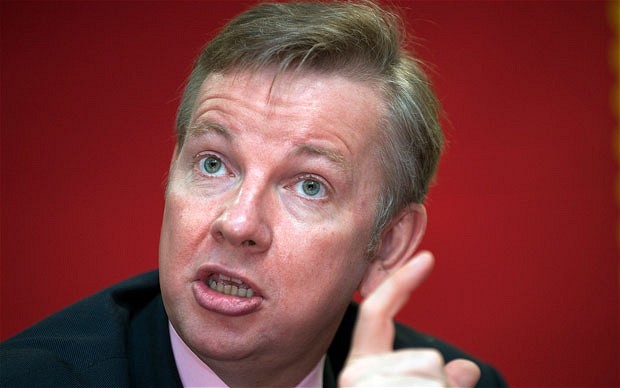
Education Secretary Michael Gove’s plan to replace some GCSE subjects by an English Baccalaureate Certificate are set to be abandoned by the government. This has been hailed as a “humiliating climbdown” by Stephen Twigg, his Labour opposite number. If Gove had pressed ahead without modifying his plans, Twigg would have charged him, as he was doing, with “not listening to reason,” and “ignoring expert advice.” Now that he has apparently listened it is a “humiliating climbdown” instead.
In my book “How to Win Every Argument” (I did not choose the title) I dealt with logical fallacies, identifying and describing some 79 of them. One of them consists in apportioning blame no matter what outcome ensues. I dubbed it “Thatcher’s Blame” because it was used so extensively against the good lady. She was first blamed for poverty and unemployment, and this switched seamlessly to blaming her for the culture of shameless affluence as yuppies emerged to flaunt their new-found wealth. The fallacy is committed because the evidence is irrelevant when guilt is ascribed no matter what happens. In the book I pointed out that if a policy is introduced first in Scotland, the charge will be made of “using Scotland as a guinea pig.” If it is done later in Scotland, the claim will be that “the Scots are being left out again.” And if it is introduced in England and Scotland at the same time, the cry will be that “government is failing once again to appreciate the essential differences between England and Scotland.” Heads you lose, tails you lose, and if the coin lands on its edge you also lose.
Thank you, Mr Twigg, for so excellent a demonstration of the fallacy.
Filed under: Updates | Leave a comment »

 Madsen Pirie