

• Adam Smith Institute

    Adam Smith Institute place holder
  • Philosophy & Logic

    Philosophy and Logic
  • Cambridge

    Cambridge
  • Children’s SF

    Children's Science Fiction
  • Enter your email address to follow this blog and receive notifications of new posts by email.

    Join 428 other subscribers

A Cambridge pathway whose surface lights up after dark with a blue glow

starpath-glow2For historic reasons some of the parks in Cambridge are called ‘pieces.’  These include Christ’s Pieces behind Christ’s College, on the main route to the Grafton Centre shopping mall with it huge multiplex cinema.  Those returning home after dark are in for a surprise, because Cambridge City Council is testing a new method of lighting the way, a method that might replace street lamps in some areas.

The whole surface of the pathway glows in the dark because it has been inlaid with ultraviolet particles that absorb light during the day and emit a blue glow after the sun sets.  The technology, called ‘Starpath’ has been developed by surrey-based Pro-Tech Surfacing.  The particles are sprayed onto the existing surface, then covered by a protective film.  The surface is fast to apply, non-slip and energy efficient.

A Cambridge City Council spokesperson tells us that the aim is to preserve the historic nature of their open spaces, while incorporating safety features.  It will doubtless be established in the trial if the light is bright enough to prevent accidents and collisions, and if it is sufficient to deter crime.  An interesting add-on feature might be the use of different coloured glowing surfaces to denote cycle lanes. The technology is cheaper and more energy efficient than conventional street lighting, and it might well give walkers a less light-polluted view of the night sky as they stroll through Cambridge.  And it is attractive to look at, too.

The experimental results of psychological tests on priming are called into question, perhaps casting doubt on ‘nudge’ politics

primingAn article in the current Economist reopens the debate about ‘priming’ and, indeed, about the validity of much scientific research that is published today. In psychology priming refers to preparing a participant before a task by setting up perceptual links in advance that will affect the outcome of the task.  Someone shown in advance the word ‘yellow’ might be somewhat faster to recognize the word ‘banana’ because yellow and banana are associated in memory so the one ‘primes’ the other.

The problem is that the published experimental results are not being replicated by those who repeat the tests.  A 1998 study found that those taking IQ tests did better if asked beforehand to think about a professor than did those asked to think about a football hooligan.  The journal PLoS ONE reported in April that nine separate experiments had not managed to repeat these results.

Nobel Laureate Daniel Kahneman, a Princeton psychologist, has spoken of “a train wreck looming” in the field because of a storm of doubt about the results.  He believes that researchers in the area might find it difficult to gain jobs because it risks being discredited.  He wants to establish a circle of researchers who will repeat each other’s results to lend them credibility.

Priming has been used fraudulently by some researchers anxious to achieve preconceived results.  They prime their subjects to increase the likelihood of the desired outcome, but without admitting this in their findings.  When later researchers attempt to repeat the work without the advance priming, they fail to replicate the results.  Priming has also been used fraudulently in legal trials, by priming witnesses in advance of their witness-box appearance.  This has been exposed in cases involving recorded evidence from children.  In one case when the full recording was later shown, including the priming, the case was instantly dismissed.

The issue has significance in the current attention being given to ‘nudge’ politics.  In such cases people retain free choices over their actions but are ‘nudged’ by alterations to the ‘choice architecture’ to make decisions that are thought to be in their best interests.  In some cases people are primed in questionnaires by being first given information or questions designed to influence their own decision.  Opinion pollsters have long known that brief statements ahead of a question can influence the answers given.  But if the published findings of priming research are themselves now doubted, then actions taken on the basis of them lose their validity and justification.  The train wreck looms.

New genetic evidence suggests we might have been wrong to regard yeti sightings as a myth

yeti-printMany people thought that the mysterious man-like animal of the Himalayas, the yeti, belonged with Loch Ness monsters and flying saucers in the category of things that thrill us with mystery but can never quite stack up enough hard evidence to confirm their existence.  Now studies by Prof Brian Sykes, an Oxford professor of genetics, suggest that the animal might be real after all.  He had two hair samples to work on; one came from the mummified remains of an animal killed 40 years ago near Ladakh in Northern India, while the second hair was found in a bamboo forest by a group of film-makers 10 years ago in Bhutan, 800 miles to the East.

Prof Sykes compared the DNA with a database of all known sequences and found there was a 100% match with that from the jawbone of a type of polar bear from Svalborg in Norway, a polar bear that lived between 40,000 and 120,000 year ago.  It means that a creature last recorded at least 40,000 years ago was alive 10 years ago in the Himalayas.  Prof Sykes suggests that the creature might be a sub-species of brown bears descended from ancient polar bears, or perhaps a more recent hybridization between the descendants of polar bears and brown bears, animals previously known to interbreed where their territories meet.  There is speculation from various reported sightings that the creature might have behavioural characteristics unlike other bears, perhaps more bipedal and more aggressive.  This goes a long day to explain the footprints that have been seen at different times.

If it turns out to be a species of bear, this will disappoint many who hoped the yeti might be a primate with both human and ape characteristics.  On the other hand, it’s exciting to come across hard evidence of a previously unknown species.  Both hairs studied were brown, and the estimate is that the creature might have been about 5ft tall.  Prof Sykes will shortly submit his findings to a peer reviewed science journal.

Many people think that the addition of bacon improves most dishes

bacon1Wired and Food Network collaborated to extract data from 49,733 recipes and 906,539 comments to find how Food Network readers thought about various foods.  They were interested in finding out how far it is true that the addition of bacon improves most things.  The smell of frying bacon is often listed among the most attractive smells, up there with freshly-roasted coffee and newly-baked bread.  The number crunchers looked at how foods were rated when they didn’t include bacon and when they did.  Added bacon improved the ranking scores of sandwiches, asparagus, lettuce. Kale, and spinach salad among others.  In fact it improved the scores of most recipes.  The notable exceptions were pasta and desserts, and this could be a texture thing, since most Americans prefer their bacon crisp and do not like it to be soggy, as it would tend to be in those foods.  People in the UK tend to prefer softer bacon (like Canadian bacon).

Clearly man and pig have been associates for millennia, and people in the US seem to think that bacon improves everything.  I’m not sure.  I don’t actually eat very much of it myself.  It’s an essential element of a ‘full English,’ and is pretty good with most egg dishes.  I often use it in quiches and frittatas.  I love it wrapped around Medjool dates at a barbecue, and perhaps very rarely in a bacon roll.  I can’t think offhand of many other times I eat it.  I don’t add to it any of the above dishes that those surveyed think it improves.  I tend to prefer lean back bacon, and don’t like it smoked.  So yes, it’s nice, but no, it’s not a wonder food in my book.

I spent part of the day learning to control a one-person hovercraft

m-hover1I enjoyed an enthralling experience yesterday learning to fly (drive?) hovercraft.  I went to Hovercraft Adventures near Sandwich in Kent to try out their one-person hovercraft.  It was a bright and sunny day but there had been rain and the ground was very muddy.  First I was taught the basics.  You kneel upright, neither forward not back.  m-hover4There are handlebars to control the air rudder, and a throttle where the brake would be on a bicycle.  Without the traction of a sea rudder or any tyres, you use the body to steer, leaning hard left or right and using the handlebars to direct the rudder behind the fan.  Steering is slow to respond so you have to think ahead for a turn.  You start by throttling up, whereupon the raft rises into its rubber skirt and moves forward.  You brake by simply releasing the throttle, making the craft slide to a halt and settling back down.  Very few of the first timers managed the tight turn on the circuit without overshooting into the thick grass.  All in all it was fantastic fun, though the mud did spray up at times.   Fortunately I’d been forewarned about it and dressed accordingly.

Why is Britain so expensive a place to live in?

tax-burdenAllister Heath, editor of City AM, answers the question.  It’s because UK taxation is too high.  Quite apart from income tax, VAT, and the other direct taxes, the indirect and stealth taxes are making us pay far too much for everything, and all to support a bloated government.

Allister Heath reminds us that petrol (aka gasoline) is subject to a 58.8% tax, not even counting the corporation tax and the North Sea Oil Levy imposed upon it.

Air passenger duty is the world’s highest, adding £94 to long hail flights and £13 for flights within Europe. And Insurance Premium Tax bumps up the cost of travel insurance on top.

Oil and gas policy and regulation added 7% to prices in 2007, but this rises to 22% by 2020

The EU’s Common Agricultural Policy is a covert subsidy we are forced to pay to European farmers.

Tax on wine is 57% of the cost of an average £5 bottle, 31% of a pint of beer, and 79% of the cost of a bottle of vodka.

The Community Infrastructure Levy routinely adds £200 per square metre to building costs, sometimes up to £575.

Planning restrictions are so tight that a hectare of agricultural land that sells for £20,000 in Oxford, becomes worth £4,000,000 if it has residential planning permission.  This restriction makes it very costly to build and raises the prices of everything produced or sold.

It all makes the UK expensive and uncompetitive.  Politicians siphon off the wealth that Britons create in order to buy votes with it.  Allister Heath’s solution?  Cut unnecessary spending and slash taxes.  It sounds easy, but we have yet to see a party bold enough to advocate it and to implement it.

Is the Earth going to survive the burden of too many people?

people-trainThe UK’s most famous naturalist, David Attenborough, thinks so.  He describes human beings as “a plague on Earth.”  It is possible that as a lifelong lover of the animal world, he sees encroachments made upon its habitat by human populations as a major threat.  The most famous contributor to the ‘population-will-ruin-us-all’ genre was “The Population Bomb” by Paul Erlich.  A 1968 best-seller, it warned of the mass starvation of humans in the 1970s and 1980s because of overpopulation.  Its predictions were inaccurate, as were Erlich’s other forecasts about Earth’s resources running out.  Sir David has even attacked IVF because it allows more people to be born.

Now IVF pioneer Professor (Lord) Winston has entered the debate to say that Sir David has got it wrong.  He points out that as we progress to stable government, education of women and decent infractructure, as in Western Europe, you have falling population.  He says that IVF makes a negligible contribution to total numbers.

The evidence backs Prof Winston.  In poorer countries people have many children because they need their economic contribution to the family budget and rely on their support for the elderly.  As societies achieve economic growth families no longer need to be so large, and state services are able to support the elderly.  The world’s population is about 7bn, and will probably peak at no more than 10bn before it levels off and maybe starts to decline.  Alarmist projections of 25bn or even 50bn are making the mistake that straight-line projections do, of failing to factor in developing changes.  As we grow richer and  smarter, our populations cease to increase explosively.  This is not without its own problems.  An ageing, declining population alters the balance between those in work and paying taxes, and those who depend on those taxes for support.

The world will not drown in people.  More people means more brain power and inventiveness, more interactivity, more wealth creation, more problem-solving.  Human beings are, said Julian Simon, “The Ultimate Resource.”

Power flour is made from insects and is a ready and cheap source of nutrition for people in poor countries

insect-flourIn the developed world insects are not a major feature of our diet.  Indeed, many will recoil at the thought, even though they might know that in other parts of the world insects make an important contribution to the human diet.  They provide protein and need much smaller inputs of energy and feedstock than do animals.  Now a group of students from McGill University in Montreal has won the 2013 Hult Prize for their project developing an insect-based flour to combat malnutrition in under-developed countries.  The prize gives the team $1m as seed money for their 5-year plan to develop ‘Power Flour’ and spread its use.

They are starting in Mexico, working with local farmers to start raising grasshoppers in large numbers.  Mexicans already eat grasshoppers, but the aim is to mass-produce them for turning into a protein-rich flour.  But the team will then go on to use other insects in different parts of the world for a similar technology, varying the insects they use in accordance with local cultures and the breeding cycles of the insects.  This might involve palm weevils in Ghana, says the report, and caterpillars in Botswana.  But the student team report that they have themselves consumed “kilos of insects” of different types during the project.

This is just the kind of project that has the potential to lift millions out of malnourishment.  Instead of providing only stop-gap handouts, it is something that local people can develop and control, turning it into useful local food production that can make a steady and important ongoing contribution to the diet of poorer peoples.  I have no idea what the various insect-based flours will taste like, though I imagine that people who already eat the insects will enjoy them.

It seems the pedants are wrong, and there is no correct distinction between ‘union jack’ and ‘union flag’

union_jackOver the weekend I saw a TV interview with a spokesman for the Flag Institute about the correct name for our national flag.  I was expecting pedantry on a grand scale, but instead listened to a remarkably sensible and well-informed account.  The pedantic myth that the term ‘union jack’ should only be used when it is flown from a ship, and that it should elsewhere be called a ‘union flag’ has no basis in history, it seems.  King James I & VI commissioned a flag to represent the union of the crowns, at which time it was called ‘the national flag’ or simply ‘the flag.’  Naval ships then flew very small flags known as ‘jacks,’ and a ‘union jack’ may simply have meant a small version of the British flag.  Historical usage shows no correct version, the spokesman told us, since the terms ‘union jack’ and ‘union flag’ were used interchangeably.  Sometimes on ships they were called ‘union flags,’ and sometimes on land they were known as ‘union jacks.’  This parlance was common at both official and popular level.  There simply is no ‘correct’ version; you can correctly use either.

I myself have always preferred ‘union jack,’ since that is now the name of the flag, whatever the historical origins of the term might have been.  I am pleased to be reinforced by the knowledge that there were no historical origins either way, but I would have continued to call it the ‘union jack’ even if there had been, since that is now its name.  As a writer I try to use language in a way that is accessible and can communicate, rather than to display erudition.  I have some (permissible) oddities.  I prefer skeptic with a ‘k’ because, like Fowler, I think the written word with a ‘c’ is too similar to septic.  I prefer the optional -ize spelling because it seems to accord more with the pronunciation.  But I am fundamentally anti-pedantic because I think language changes over time with use.  It is sometimes worth making a stand when usage loses or blurs an important distinction, but English often tends through usage to establish slightly different meanings for what were once synonyms.  Thus ‘celibate,’ which once just meant ‘unmarried’ has fairly recently diverged in meaning to refer to sexual abstinence.  But (he said, starting with a conjunction for the second time) I see little point in correcting people for using language in the ways that other people use and understand it.

The Segway might have made a major contribution to urban transport, but it has not done so yet.

When the Segway was being developed amid great secrecy as “Project Ginger,” the hype was that it represented the future of urban transport.  It has instead remained largely a niche product used for fun by tourists.  Many things counted against it.  Firstly, it’s very heavy, too heavy to lift readily up a flight of stairs.  Secondly, it’s too expensive, costing over £5,000 a throw.  Thirdly, the attitude of governments has been mixed, with some like the anally-retentive UK Dept of Transport banning the thing from pavements altogether, and requiring it to compete with buses and heavy goods vehicles on overcrowded urban roads.  Given its low profile, that would be near suicidal.  The Segway was designed for city pavements (sidewalks).  Users and pedestrians have no difficulty avoiding each other wherever they share space, much as cyclists and pedestrians largely do in pedestrianized areas.

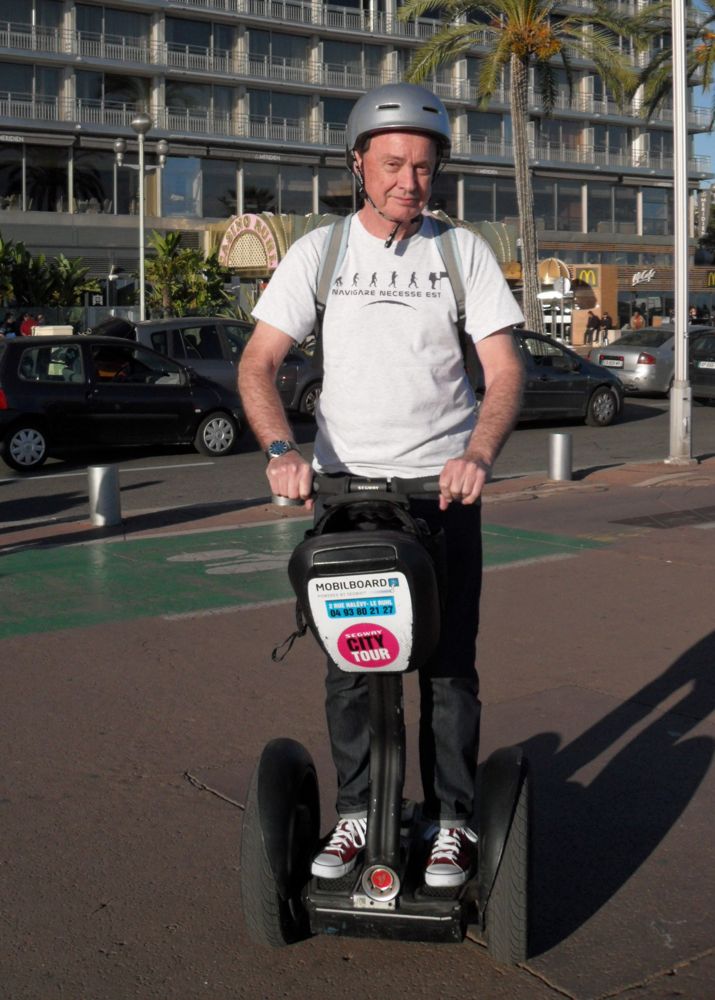
I’ve ridden Segways many times in Nice (photo above of me doing so last Friday), taking them through the narrow streets of the Old Town and through the market crowded with shoppers.  It’s not a problem.  They are very intuitive to use, since gyroscopes detect the body’s motion and tell the electric motor what to do.  Lean forward to go ahead, lean back to brake or to reverse.  It takes most people about 8 seconds to get the hang of it.  It’s pretty safe, and it’s great fun.