

• Adam Smith Institute

    Adam Smith Institute place holder
  • Philosophy & Logic

    Philosophy and Logic
  • Cambridge

    Cambridge
  • Children’s SF

    Children's Science Fiction
  • Enter your email address to follow this blog and receive notifications of new posts by email.

    Join 428 other subscribers

Traditional pies and puddings that put Britain on the global map

puddingThe Telegraph has an engaging feature about what has made Britain famous around the world.  No, it’s not the industrial revolution or the Empire, it’s our traditional puddings.  Different localities all have their own, and the Telegraph is calling for a revival of traditional recipes as a patriotic duty.  Most of them I’ve never heard of, but they include Mucky mouth pie, an apples, bilberries & mint pie.  Then there’s Devonshire apple dappy, “a delectable sticky, appley pud that looks a little like a tray of Chelsea buns, but with a richer, more crumbly dough.”  An old Jewish delicacy is London stuffed monkey, a shortbread-like pastry tart, filled with ground almonds and candied peel, plus sometimes currants.  There’s Wilfra apple tart with apples and Wensleydale cheese, and the utterly weird Bedfordshire clanger containing pork belly slices, onion & apple. Oldbury tarts are gooseberry pies with pastry like a pork pie crust, and the only one I have heard of is Clootie dumpling, made with steamed suet with dried fruit and spice cooked in a cloth (clootie).  There’s no mention of my signature dish – English summer pudding, perhaps because it’s national rather than regional.  Looking at the recipes reproduced in the article, I’m tempted to try my hand at making a couple of them, just out of patriotism, of course.

Videogames designed to help the minds of older people to remain alert and active.

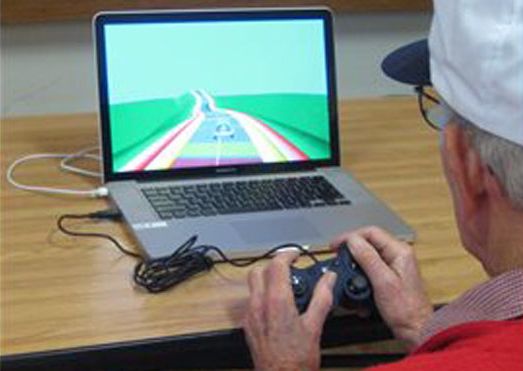
old-video gamesIt’s a commonplace that physical activity can keep older people healthy.  Although the body deteriorates with age, regular exercise, even light exercise, can keep it in better condition for longer.  Intuitively we think the same might be true of mental activity.  If we exercise the brain by getting it to perform tasks, maybe we can keep it more active and remain more alert as we grow older.  Now there’s a report about video games specifically designed to aid cognition and memory in older people.  Video games to improve mental skills are not new, but some question whether they improve our ability to cope with the world, as well as improving our video-gaming skills.

Neuroscientists at the University of California, San Francisco, have developed NeuroRacer, a game that requires its players to multitask.  They must press a button to respond to different symbols that appear, while also using a joystick to drive a car along a winding, hilly track.  Two groups were tested playing the game.  174 players of various ages played it wearing electroencephalography (EEG) caps that read electrical activity in their brains, then 16 older people aged 60 to 85 took the game home to play on laptops three times a week for a month before returning to play it in the lab again wearing the EEG caps.

“After training, the older adults showed improvements in their multitasking skill, measured by how little their performance dropped when the driving task was added on top of the symbol task. In fact, they scored better than untrained 20-year-olds. They also maintained this skill for 6 months after the training, without further practice. The gamers showed changes in the rhythmic firing of neurons in the part of the brain known as midline frontal theta. This response, which is thought to be associated with memory and attention, occurred right after a new target symbol appeared on the screen and was more pronounced in younger players. But after the older players trained, this pattern strengthened.”

This does seem to suggest that playing the game had produced changes in the brain that improved its abilities.  Indeed, further tests showed that the test group performed better at memory and cognition tasks.  All of this came from only a few hours of play, which suggests that this might be a promising way of enabling older people to stave off the mental decline that often accompanies ageing, and remain independent for longer.

A fusion breakthrough releases more energy than it takes to achieve it

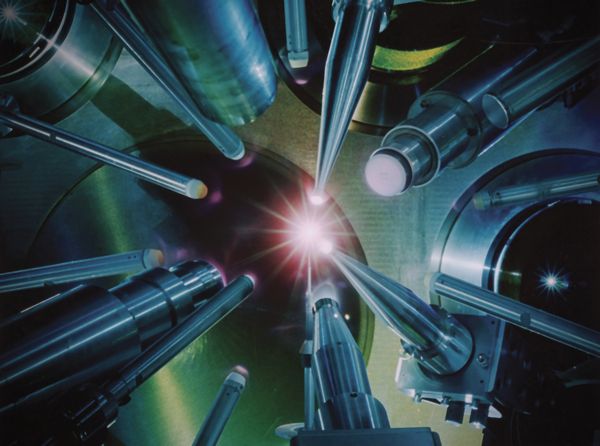
fusionTwo stories concerning particle physics made the news this week.  One was the award of the Nobel Prize to Higgs and Englert for their work on the ‘Higgs Boson’ as an explanation for the origin of mass.  The other is the less noticed announcement from the National Ignition Facility based in Livermore, Ca, that scientists there have achieved fusion in which the energy output exceeded the amount of energy absorbed by the fuel.  This is an important step on the road to self-sustaining fusion as a source of energy.

Although we have seen stories for decades about fusion as the source of unlimited cheap power “just around the corner,” it has hitherto taken more energy to achieve fusion than has been released in the process.  The technique used by NIF was to take a small pellet of extremely cold, solid isotopes of hydrogen and bombard it in a container by 192 beams from the world’s most powerful laser.  The X-rays from the container’s walls heat it to millions of degrees and fusion takes place with its release of energy.  It is not quite there yet because inefficiencies mean that not all of the energy supplied to the lasers makes its way to the fuel.  That which does is exceeded by the energy produced, so it takes us tantalizingly closer to self-sustaining fusion.

What an exciting world we live in.  New technologies are constantly being developed with the prospect of enhancing the way we live and the opportunities available.  I doubt we’ll any time soon have the “Mr Fusion” device of “Back to the Future,” but if we do, you can bet the car will be driverless…

GlaxoSmithKline seeks approval for the world’s first viable anti-malarial vaccine

falciparumA major milestone has been passed in the fight against the world’s leading cause of illness and death.  Malaria, which has killed more people than all of the wars of human history, kills about 800,000 people a year, three quarters of whom are young children, mostly in Africa.  Now GlaxoSmithKline has unveiled a vaccine at a meeting in South Africa, giving details of a trial involving 15,500 children in seven countries.  Eighteen months after vaccination, children aged five to 17 months showed a 46% reduction in the risk of clinical malaria, and in children aged six to 12 weeks at vaccination, a 27% reduction in risk.  This means that hundreds of thousands of lives could be saved with it each year.

I’ve not seen many details yet, but the vaccine appears to work at the pre-erythrocytic stage, before the plasmodium falciparum emerges from the liver and invades red cells.  A key factor in its adoption and use will be cost. GlaxoSmithKline has declared its intention to produce and distribute the vaccine without seeking any profit, which is admirable.  If it can be done at less than $1 a dose, it will be widely used.  Credit is also due to the non-profit Path Malaria Vaccine Initiative (MVI), and to the Bill & Melinda Gates Foundation which helped with the funding.  This is excellent news, and will hopefully be only a first step when it starts to be used, perhaps in 2015.  It is not a complete answer, but with bed nets, insect repellents, malaria drugs and the targeted killing of mosquito breeding grounds, plus the development of more refined versions of vaccines, we can finally begin to eradicate humanity’s oldest enemy.

It becomes possible to know the traits that our children might inherit, and some people question whether we should act on this

babies in cotsSome degree of concern has been elicited by a new patent from 23andMe, a consumer genetics company co-founded by Anne Wojcicki, the recently separated wife of Sergey Brin.  The company offers DNA testing services for parts of the genome covering 960,000 single nucleotide polymorphisms.  I had myself tested a few years back, sending them a saliva sample and receiving a detailed printout of parts of my DNA sequence,  It covered a range of possible conditions and told me the percentages of those with similar genomes to mine who contracted those conditions.  In effect, and crudely, it told me the odds of my suffering dozens of conditions including coronary heart disease, arthritis, Parkinson’s Disease, and glaucoma, among many others.

The recent concern has been over a new service that can tell customers the chances that any baby born from another 23andMe customer will have of inheriting specific properties.  A group of bioethicists have questioned the morality of this in Genetics in Medicine, and the Center for Genetics and Society has called on 23andMe not to proceed with a system that might allow parents to choose specific properties in their offspring.  The words “designer babies” have been raised.

While the first aim of the new system is principally to allow parents to know the chances of any progeny developing specific diseases, the worry is that it might be taken further.  Given the chance to avoid bringing a child into the world to face a life of suffering, many parents would take it.  The technique could later be developed to increase the likelihood of non-disease traits being inherited, such as, for example, intelligence or musical or mathematical ability.  I am relaxed about this, taking the view that when humans can take steps to improve their chances of having happy, healthy and yes, talented children, they should be free to do so.  We long ago starting imposing our wishes on nature about the outcome and incidence of our lives and deaths.

Can you affect your fortune by bad luck rituals such as touching wood?

3149480819_c779ebf78e_zA headline in the Telegraph tell us that research has established that we can affect our fortune by engaging in ritual responses to avert bad luck.  “Bad luck really can be reversed by touching wood ritual say scientists,” it proclaims.  Then you read the report to discover that it says nothing of the sort.  What the researchers, from the University of Chicago Booth School of Business actually claim in the Journal of Experimental Psychology is that the rituals affect people’s concerns about their fortune, not the actual fortune itself.  Rituals that involve pushing something away or exerting force make people more likely to feel they have pushed bad luck away.  So striking wood and saying “touch wood” or throwing spilled salt over your shoulder make you feel that you have averted future misfortune.

This is not about changing the universe, it is about changing the way you feel about the universe.  Yes, you go through the ritual and feel that you have somehow affected future things you have no control over.  This is not very different from dancing round a totem pole and chanting in order to bring rain.  Both give the illusion, a comforting illusion, that you can control the uncontrollable and alter events in your favour.  It is just possible that this feeling that you have warded off misfortune might change your behaviour in ways that make bad things less likely to happen.  On the other hand, it might just as well make you more reckless, feeling that you have averted bad stuff and therefore not being as cautious about avoiding it.  I tend to the view that these rituals, some of which date back millennia, comfort us, and that’s why we do them.  They don’t actually change things, just our thoughts about things.

The full Scottish breakfast outdoes the full English in calorie content

scots-breakfstI was visiting St Andrews for a Union debate.  St Andrews is one of my almae matres.  It was where I did my PhD.  How pleasant to be back among the grey stones and red gowns of Scotland’s oldest university, one this year celebrating its 600th anniversary.  The students were just as bright, alert and engaging as ever, and conversation went on late into the night afterwards at the West Port tavern, located appropriately enough next to the West Port, one of the old city gates.

Next morning at my hotel breakfast I saw a “Full Scottish Breakfast” on the menu.  I know and sometimes enjoy a “full English,” but this was new to me.  It consisted of “sausage, bacon, egg, haggis, black pudding, potato scone, beans, mushrooms and tomato.”  Wow!  I didn’t eat it, but opted instead for scrambled egg with (masses of) smoked salmon.  It did set me thinking, though.  I guess if you’re about to set out on a challenging golf course in a force 9 gale, it might be just the thing to sustain you, but I have to say that it looks intimidatingly calorific.  At a rough guess I would say there’s probably more than a day’s quota of calories in that plateful.

I note that Scotland has a problem with obesity, with roughly 28 percent of adults and over 30 percent of children classified as obese, and about 64 percent of Scots reckoned to be overweight.  No doubt eating habits that include the infamous deep fried Mars bar have something to do with it, plus a fondness for the sugary foods that once were the luxuries to enliven an otherwise plain diet.  I think I’ll carry on with my porage every morning, which I note was spelled ‘porridge’ in the English style on the hotel menu, presumably for the benefit of the American golfers who stay there.

The Prime Minister doesn’t know the price of a bread loaf, and the Mayor of London doesn’t know the price of a pint of milk

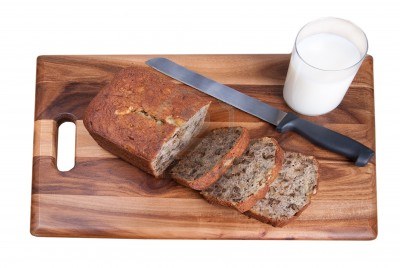
loaf&milkIt was originally billed as a gaffe when David Cameron was asked in an interview how much a ‘value’ loaf of bread costs in a supermarket, and didn’t know.  He thought it might be “north of a pound” whereas apparently it’s 49p.  He recovered well by saying that his family made their own bread fresh every day in a Panasonic bread-maker, so they never bought bread from a shop.  Boris Johnson then helped him out by admitting he didn’t know the price of milk, and that basically the two of them had better things to do than go round supermarkets comparing prices.  Well said, Boris.  I’d rather the PM secured an economic recovery for the nation than saved a few pennies for his family, and I’d prefer the Mayor to keep London moving than to push his own trolley.  I’d rather they knew the prices of gold and Brent Crude than those of bread and milk.

I personally have no idea what a ‘value’ loaf costs.  The only sliced bread I buy is a medium, last-extra-long, brown loaf costing 90p, and I use it to make English summer pudding.  I regard white sliced bread as having no redeeming features, but I can see how it might appeal to parents with hungry children.  As for milk, I buy only semi-skimmed goat’s milk costing £1.55 for a litre, which must be about 88p a pint.  I do wish interviewers would stop this silly nonsense of calling our leaders “out of touch” if they don’t shop personally for the groceries.  I have no idea what regular sliced bread and milk cost, and don’t need to in order to make pertinent comments on the state of the economy.

The trend to kitchen eating seems to be leading to the demise of the dining room

nice kitchenA report from Lloyds Bank Home Insurance has revealed that more and more of us entertain in the kitchen rather than the traditional dining room, which most homes still have.  Depressingly, many families buy sectional sofas, which are really comfortable, true, and eat in the living room in front of television.  Six out of ten of us apparently have friends to “kitchen suppers.”  Even the Prime Minister does this in Downing Street, according to Francis Maude.  Presumably his £100 Panasonic bread-maker features among the £4,909 worth of gadgets the average kitchen is equipped with.

I don’t actually have a dining room, but an area separated by Japanese screens from the cooking part of the kitchen.  It’s where I entertain friends.  Another feature of the report is its revelation that almost a third of houses these days have a separate office or study.  Again, my ‘office’ is a well-lit area off the living room, one floor up from the kitchen/dining area.  It is what happens when you have a fairly long thin house.

In a speech to Mensa in 1984 I made predictions for the year 2020, and one of them was that most families would eat in the kitchen.  Kitchens have changed from being small functional areas where you cooked into large and pleasant spaces where you can relax.  If they are nice places, it’s easy to suppose that people will spend more time in them.

Anti-noise cancels out sound waves, and now a ship’s anti-waves deaden its response to the sea’s motion

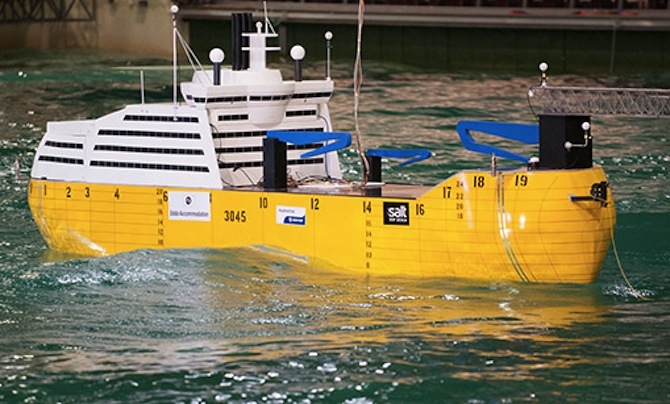
ASV_DesignIt’s a very novel idea designed for the Norwegian firm Østensjø, which services marine platforms such as oil and gas rigs.  Wired reports that it’s a ‘hotel ship’ that can accommodate and entertain up to 800 workers, and the aim is to make it as stable as possible.  The ship has U-shaped water tanks in its hull that create waves internally to counter external ones in the ocean.  They produce waves in opposing phase to those acting on the hull, and thus stabilize the vessel.

Air valves at the top of the tanks determine the movement of the water in the tanks. Just as a sailor’s sea legs constantly adjust to the pitch and roll of a boat, the motion of the water in the tanks is calibrated to match the strength of the waves on the sea. That helps the ship stay stable.

There’s an important safety aspect, too, in that it helps the ship to service rigs even in rough seas by enabling the ship to keep its position relative to the rig.  The photo (by Marintek) shows how the ship will look when completed in mid-2015.  And of course anyone who’s ever been seasick cannot wait for the technology to spread to cruise ships and transatlantic liners…