• Adam Smith Institute

    Adam Smith Institute place holder
  • Philosophy & Logic

    Philosophy and Logic
  • Cambridge

    Cambridge
  • Children’s SF

    Children's Science Fiction
  • Enter your email address to follow this blog and receive notifications of new posts by email.

    Join 428 other subscribers

Coming talks

I’m addressing school sixth-formers on Thursday 11th, and will probably expose some of the common errors and fallacies of economic thinking.

On Friday I’m speaking to the Cambridge Libertarians and have been asked to do an introduction to free market ideas on a philosophical level, so I’ll treat the market as a spontaneous development from the ways we developed for dealing co-operatively with each other for mutual advantage.

On Monday the ASI is holding a tribute evening to Milton Friedman in his centenary year, with details on the ASI website.

An Agenda for Growth

The ASI meeting at the Conservative Conference was packed.  There were about 100 in a room that could seat 50, so it looked crowded, and some who came late could not gain entry.  The four speakers did well, covering their subject in 10 minutes each before taking part in questions and discussion with the audience.  All the speakers thought that government had to cut its spending and to lower taxes, especially on business.  There was some discussion of what was necessary to boost growth, and what might be possible in a democracy with a coalition government.

Cambridge debate

When we debated the motion that “Capitalism has failed” at the Cambridge Union on Thursday, we actually won the vote, to my surprise.  There were just under 500 people in the chamber, plus about 300 watching in separate room on closed circuit TV, so it was a full meeting.  We decided that it was not capitalism that had failed, but the alternatives…

Good things with bad press

I’ve been doing a series about some of the things that, while they are very good, come in for much criticism and misunderstanding.  These are being posted on the ASI blog (www.adamsmith.org/blog) under my name.  The first four covered advertising, bankruptcies, profits and imports, but there will be at least ten of them in the series, maybe more.

The fact that things like these gain such a bad press is perhaps indicative of a general lack of understanding about how economics works, and of the limitations that come up when politicians try to steer it.

Conference fringe event

On Monday 8th October I’m chairing a fringe event during the Conservative Conference in Birmingham.  It will cover “An Agenda For Growth” and the speakers will be Dan Hannan (MEP and author), Kwasi Kwarteng (MP and head of Free Enterprise Group), Andrew Lilico (Economist), and Geoff Cook (CEO of Jersey Finance).

It starts at 3.30 with an afternoon tea buffet, then the speakers have 10 minutes each, followed by questions and discussion.  It takes place at The Jury’s Inn Hotel, 245 Broad Street.

Speeches

That Cambridge Union debate on the motion “That Capitalism Has Failed” was quite fun.  Our side, in opposition to the motion, made the case that capitalism has been history’s most successful form of economic organisation.  We spoke before a packed house of over 500, with yet more watching in other rooms on closed circuit TV.  When it came to the vote the motion was defeated by a substantial majority.

The following morning I addressed nearly 300 sixth-formers in London at the ASI’s Independent Seminar on the Open Society.  I explained that it was important to understand economics in order to increase its potential to improve the world.  I took the view that economics is not, and never can be, a science like Physics and Astronomy because it deals with people.  Atoms and stars do not change their behaviour when they have more information, but people often do.

Media stuff

I appeared in the BBC2 programme on Marx in the “Masters of Money” series.  It can still be seen on iPlayer.  My contributions are at 25.40 and 42.13 minutes.

I was accused by George Monbiot in the Guardian of running the country and subverting democracy (win some, lose some).  The link is:

http://www.guardian.co.uk/commentisfree/2012/oct/01/rightwing-insurrection-usurps-democracy

I finished another children’s sf book, my first sequel.  When it comes out in print it might be called “Children of the Night – Silver Dawn.”  My other children’s books are available on Kindle at 77p.  I wanted to offer them free, but you can only do that for Amazon-published books or classics.

I’m speaking at a debate in the Cambridge Union on Oct 4th.  The motion is that “Capitalism Has Failed,” and no surprises to learn that I am opposed.

Economic ideas and politics

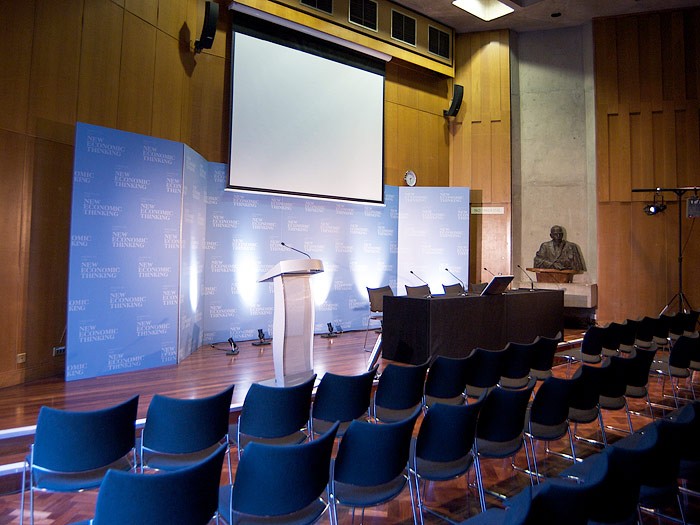
I addressed a meeting of Cambridge University’s Marshall Society in King’s College.  It was in Keynes Hall, with a bronze bust of Keynes looking in from the side of the stage.  My theme was “The Influence of Economic Ideas on Politics,” and I began with Adam Smith, the Scottish economist who overturned the prevailing view that nations became rich by exporting more than they imported.

Influenced by Smith’s ideas, successive British governments liberalized duties, taxes and regulations, culminating in the repeal of the Corn Laws in 1846.  It unleashed a period of unparalleled prosperity in Britain.

Next I cited John Maynard Keynes, who taught that governments could regulate the business cycle to some extent by “priming the pump” with public spending at times of insufficient private spending to boost employment levels.  The Keynesian approach dominated the post-war consensus, with government playing an active and leading role in economic management.  Politicians liked to be seen to be doing things and in control instead of simply reacting to events.

Although Milton Friedman was famous for monetarism, I suggested he probably played a larger role in discrediting government intervention and boosting the case for private enterprise and opportunity in its place.  He certainly played a leading part in emboldening governments to undertake privatization and the reassertion of market economics in the final quarter of the last century.

Following the financial crisis of 2008, I suggested that the Austrian School was now winning the argument about its causes, pinning responsibility firmly on the cheap borrowing instigated by governments and central banks that lay behind the credit bubble and the careless risk-taking that accompanied it.

My final note was that despite what economics teaches, politicians would probably continue to advocate silly things such as a financial transactions tax, or punitive tax rates on high achievers, and would continue to damage and limit wealth creation by an excessive preoccupation with its redistribution.

Nice review of ‘Think Tank’

Professor Donald Abelson has given rather a good (and favourable) review of my book “Think Tank – the Story of the Adam Smith Institute.”  It was one of my hopes when writing it that it would find its way into the literature of political studies, and onto the shelves of university politics department libraries.  This is quite a good start in that direction.

His review is here:

The influence of think tanks: presenting the right ideas, to the right people, at the right time

and the book is available on Amazon here:

Think Tank: The Story of the Adam Smith Institute

Freedom Forum

I spoke at two sessions of the Liberty league’s Freedom Forum in Newcastle at the beginning on the month.  It was a hugely successful weekend, with 120 students from all over the UK attending sessions with a libertarian and free market theme to them.

I spoke first on how to put across the central ideas of Austrian Economics to make them seem like simple common sense, drawing heavily on my “Economics is Fun” series of videos.  In my other session I explored two different routes of libertarian ideas.  One is the deductive school which derives the principles of liberty from what are claimed to be undeniable premises.  This is the school of von Mises, Rothbard and Ayn Rand, and draws on a style of reasoning used by Aristotle and Thomas Aquinas.  The other is the empirical school which finds that societies which have stressed individual liberty and property rights have been better in practice at securing the general benefit of their members.  This school includes J S Mill and Friedrich Hayek, and uses a style of reasoning employed by David Hume and perhaps John Locke.

There was much discussion afterwards of the relative merits of liberty, which I favour, versus equality, which I rate less worthwhile than liberty and opportunity.  It is interesting to see how libertarian ideas are becoming ever more widespread among young people.  It is a phenomenon so pronounced that it is bound to attract national attention fairly soon.