Has anyone spotted how successful so far has been NASA’s switch to seeding private firms to supply the International Space Station? First were the two visits of the Dragon capsule from SpaceX, and now today the Cygnus craft from Orbital Sciences will dock there. Launched from a two-stage Antares rocket last week on a “demonstration mission,” Cygnus has been performing a series of manoeuvres to alter its orbit and ultimately take it alongside the ISS. There will be a deliberately aborted approach before it is finally parked 10 metres away in drift mode so it can be grabbed by astronaut Karen Nyberg with the robotic arm, where tomorrow begins the unloading of 1,500lb of supplies. NASA’s £1.2bn contract with Orbital Sciences covers 8 visits to the station. Unlike Dragon, Cygnus will be loaded with garbage and allowed to burn up during its descent towards the Pacific.
NASA’s use of private contractors, all founded by internet billionaires, seems to have reinvigorated the space programme. Since manned vehicles are scheduled to join the line-up of private spacecraft, it looks as though the tactic will make space cheaper and more accessible, as well as taking it out of the monopoly hands of governments. It’s all becoming interesting again…
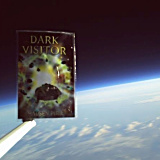
Some hype has accompanied a report that UK scientists have found life in space. Newspapers and TV stations find it difficult to resist stories about aliens visiting our planet. In this case the alleged aliens are microscopic, found in the upper atmosphere, and believed by the research team to have descended from interplanetary space in the Perseid meteor shower. The Sheffield team sent a balloon to take samples at 13 and 16 miles up, using sterilized equipment. A drawer opened with studs on which minute particles could settle, and closed until it could be examined by scientists back on Earth. They report evidence of a single-celled lifeform called a diatom. They found nothing actually alive, but what they found came from living creatures. Prof Milton Wainwright attempts to ward off the suggestion that these particles originated on Earth and were carried aloft, possibly by a volcano. He points out there have been no major eruptions for 3 years, though other scientists have suggested that the cumulative action of smaller volcanoes could achieve a similar effect. Eyebrows have been raised that the paper was published in the Journal of Cosmology, often criticized by the scientific community for some of its ‘way-out’ articles.
Well, did it happen? Scientists have responded with doubts and questions, pointing out that the particles discovered resemble ones already known to exist on Earth. No doubt the isotope tests will tell us if the ratio of isotopes matches that found in Earthly matter or that found in space debris. My initial response is skepticism. I don’t doubt the findings, only the extra-terrestrial explanation. It looks at though Earthly particles, including organic ones, have been carried aloft by terrestrial forces, be they volcanoes or hurricanes. They might have remained some time drifting in our upper atmosphere. It seems strange at first sight that material previously retrieved from meteorites, and even that captured and returned from comets, shows no similar evidence of these type of lifeforms. While I am ready to be convinced, and would quite like it to happen, I’m sitting this one out until more convincing evidence comes along.
One of the fun things about science is that in many, if not most, fields, there are competing theories, each with its school of adherents, each anxious to validate its view via experiments. Were the dinosaurs killed by volcanic gases, or was it a comet from outer space? Was Tyrannosaurus a predator or a carrion eater? The two schools of thought test each other and science advances. Now let’s look at where gold comes from. There’s about 1.3gm of it per 1,000 tonnes of other stuff, and that’s too much. When most of the iron at Earth’s formation collected at the molten core, most of the gold should have gone with it, but there’s more of it in the crust than there should be. The prevailing theory, the late veneer hypothesis, has it that bombardment from space by meteorites and asteroids gave us most of the gold available to us. Several experiments have backed this up, including examination of lunar rocks following the Apollo visits. Those same meteorites, or similar ones, might also have delivered the carbon, nitrogen and water that were essential to the development of life. Incidentally, isotope measurements suggest that 0.5% of the Earth’s crust is meteoric in origin – that’s about 20 billion billion tones.
Theory number two tries to deal with anomalies in the late veneer hypothesis. It suggests that the Earth’s gold was here all along. Most of it went to the core with the iron, “but a significant proportion – perhaps 0.2% – dissolved into a 700km deep magma “ocean” within the Earth’s outer mantle. Later, the gold was brought back up to the crust by volcanic action.” Under this theory gold has to be more soluble than previously thought in order to match the numbers. The numbers seem to match for the late veneer hypothesis, so it currently finds more favour among scientists.
A common figure for the total quantity of gold ever mined suggests that it would fill about one-third of the Washington monument. And it seems likely that all of it might have come from outer space. I’ll never look at a gold medal in quite the same light…
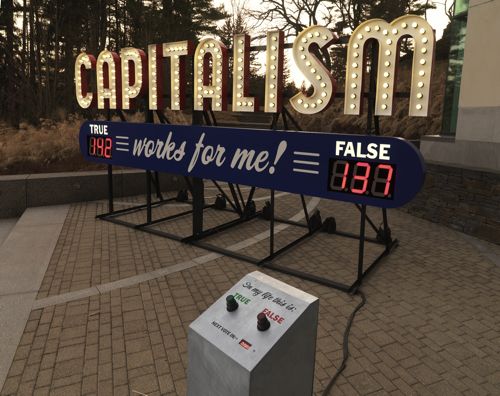
New York based artist Steve Lambert has posed an intriguing question at the edge of Times Square. It’s a 20 ft by 9 ft illuminated sign that says “Capitalism Works For Me,” and is equipped with a mechanism by which people can register their vote for or against the idea. The answers are posted on a scoreboard alongside the letters. It’s a great idea, in that art is supposed to set you thinking, and this one will do that for many people. I suppose the question that might spring to mind is “What sort of capitalism?” Many people might say that capitalism gives them their job, their livelihood and the chance to get ahead, meaning the system by which people invest in producing goods and services in order to profit from doing so.
They might nonetheless draw the line at crony capitalism under which big companies get into bed with politicians in order to keep out competition and to gain more money that people would hand them under a truly voluntary market. This is rent-seeking rather than capitalism, and is regarded as a perversion of capitalism as it should be. Many might resent the use of money taken from taxpayers to bail out insolvent corporations that would just go to the wall under real capitalism, and perhaps should be allowed to do so. As I said, the question will set some people thinking, and that is no bad thing.
A new study published in Lancet Oncology suggests that such lifestyle changes as exercise, diet and stress reduction can actually lengthen the telomeres that control cell ageing. These are the DNA strips at the end of chromosomes that protect the integrity of the DNA in our cells. They have been likened to the plastic tips of shoelaces that stop our DNA unravelling and fraying. They get shorter each time a cell divides until they can no longer do the job and the cell ceases to function.
University of California scientists studied 10 men with prostate cancer who were asked to implement lifestyle changes against a control group of 25 who were not. The changes included exercise, stress-reducing meditation and a plant-based diet. After 5 years the telomeres of each group were examined. Those making the changes showed an average 10% lengthening of telomeres, whereas the control group showed a 3% average shortening. This is a tiny study, but it points the way to future research that might be done. It does not necessarily show longevity, though future studies might.
Most of us were already inclined to suppose that cutting down on fats, eating more vegetables and taking regular exercise would improve our health, and many think that controlling their stress levels helps. These things have been associated with reduced risk of cancers, diabetes and heart disease, and now the possibility is opened up that they might help us to combat and even modestly reverse the ageing process.
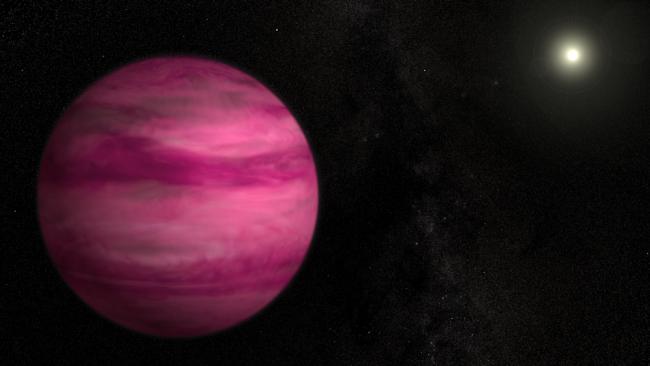
There’s a large newly-discovered planet 57 light years away that’s a deep magenta in colour, and which orbits its star at a distance much farther away that Neptune is from our own sun. GJ 504b is roughly Jupiter’s size, but several times its mass, and it’s about 4.05 billion miles from its star. If planets are formed by accretion within the debris field surrounding a star, we can have gas giants formed as more objects within a band are swept up. The problem is that Neptune is about at the outer edge of where a gas giant can be formed by this process, yet the pink one sits way beyond that. There ought not to be enough stuff out that far for it to become that big.
This is the second time that the Hubble Space Telescope has found a planet that sits farther out from its star than the current theory allows for. We might have to go back to the drawing board and come up with alternative ways in which planets are formed. On the other hand, it might just turn out that GJ 504b turns out to be a captured proto-star rather than a conventionally formed gas giant that was formed in its present location.
Scaled Composites is the company founded by Burt Rutan that designed and built SpaceShipOne, winner of the X-Prize. The rocket plane completed the requirements by making two successive flights into space after launch from a mother ship. Now the work is on a larger machine, SpaceShipTwo, that is launched from its White Night lifter to provide Virgin Galactic’s paying customers with the experience of space and zero-g.
Some of the team spend their leisure time in evenings and weekends in building and flying light aircraft to compete in events like the Reno races. Elliot Seguin, a flight test engineer and pilot might spend his day at the computer or aboard White Night conducting tests. But in his down time he’s designed and built a Formula 1 class racer, and following SpaceShipTwo’s second powered test flight last week, he headed out to Reno to enter the races.
“The Formula 1 class of air racers is tightly defined. The airplanes must have at least 66 feet of wing area and weigh at least 500 pounds. They are also all required to use the same Continental 0-200 engine (though they can be highly modified). So anybody looking for maximum speed tries to build the smallest, most slippery airframe possible.”
Seguin’s problem was that most aircraft in the class do not give him enough leg-room to fly effectively. At 6ft 3ins he had to make something he could fit into. The result is his Wasabi Formula 1 air racer, designed to fly fast and low round the pylons dotted through the course circuit. In some ways his activities call to mind those of Burt Rutan himself, who loved flying and creating custom-made machines to test his skills. Rutan ended up with technology that is about to make civilian spaceflight a practical and commercial reality. He confirms that we still live in a world where people can set themselves adventurous and ambitious targets and can, by attaining them, advance the progress of humankind and the opportunities open to it.
The UK government proposes to make supermarkets in England charge 5p for plastic bags from 2015 onwards. Northern Ireland and Wales already impose charges for bags, and Scotland intends to do so from next year. Several countries outside the UK, notably France, already do this. The proposal is that the money so raised will not go to the stores themselves or to the government, but to “environmental charities.” The problem has been that over 8 billion bags are used annually in the UK. They can take 1,000 years to decay, and present a danger to wildlife on land and at sea as well as being a blight on the natural beauty of the countryside.
Two modest tweaks would improve this proposal and increase its acceptability and popularity. To charge shoppers an extra 5p per bag at a time when many families are struggling to make ends meet is bad timing. An exemption should be made for biodegradable bags. I was surprised some time back to see that what seemed like a clear plastic sheet covering my sandwich was described as degradable, and was apparently derived from corn. Several biodegradable clear food wraps are already on the market, and I doubt it would take much to develop a shopping bag designed to degrade within a set time. We could even put up a worthwhile prize for the inventor who manages to produce one cheaply enough. Supermarkets might wish to offer the option of free biodegradable bags as alternatives to 5p plastic ones.
My second tweak is that “environmental charities” which undertake political campaigns should be excluded from those receiving the proceeds of the 5p charge. It might go instead to those that do practical work to protect wildlife and habitat, that clean up rivers, etc. It should not go to those that campaign against business and lobby for new and higher taxes, or for those that seek to limit our behaviour to what they deem acceptable. Given those two tweaks, I think the proposed 5p charge will attract fewer grumbles that it will without them.
Lawyers for the European Council have advised EU countries that the financial transaction tax (aka Tobin tax) which 11 EU members propose to introduce will constitute a breach of EU rules. The proposal was to tax trades in shares, bonds and derivatives by EU institutions wherever they were in the world, but the new advice points out that this would have involved imposing taxes on countries that have not signed up to the rules.
If the tax goes ahead it will most likely now be limited to instruments issued in the 11 states that support the tax. But if the participating EU members ignore the advice and attempt to impose the residence principle, legal advice suggests they will open themselves to lawsuits for damages running into astronomical sums. The aim was to apply the tax to all institutions registered in an EU country, no matter where the trade took place. It would have applied if a UK firm traded in London with local branches of French or German banks. This would have cost thousands of jobs in the City of London, even though the UK opposes the tax and will not introduce it. Now it will be far less damaging.
The FTT was always misconceived. It was not expected to raise significant money, but forms part of an Imperial EU seeking to expand its powers and looking for ways to levy its own taxes directly on EU citizens without having to receive them from governments. It was supported by a motley collection of economic ignoramuses who think government’s job is to take money from those who make it and give it instead to causes the tax’s supporters approve of. As originally conceived it would have seriously damaged financial markets and imposed costs even on those wanting to change money to take on holiday. For this relief, much thanks. The best hope is that the stupid idea is abandoned altogether. The second best is that its damage is confined to those daft enough to implement it.
This weekend Elon Musk’s SpaceX is scheduled to test-fly its Falcon 9, a new stretched version of the Falcon series. There is a Canadian payload on board, but Elon Musk points out that the Falcon 9 has a lot of new technology on board, with a correspondingly high risk of failure on a first flight. On the way down SpaceX will try to relight the engine just before splashdown, in a further test of the technology that will enable a rocket to return to its landing site in a controlled descent. The recent Grasshopper flight (above video) not only tested this, but managed to frighten a small herd of cattle at the same time! (Watch them in the foreground at the bottom of the frame).
From the other side of America on September 17th Orbital Sciences is set to follow SpaceX’s Dragon by sending its Cygnus craft to rendezvous with the International Space Station with some non-essential cargo. Launched atop an Antares rocket from Wallops Island, the Cygnus will burn up (loaded with trash) on the way down after a month in orbit with the ISS.



 Has anyone spotted how successful so far has been NASA’s switch to seeding private firms to supply the International Space Station? First were the two visits of the Dragon capsule from SpaceX, and now today the Cygnus craft from Orbital Sciences will dock there. Launched from a two-stage Antares rocket last week on a “demonstration mission,” Cygnus has been performing a series of manoeuvres to alter its orbit and ultimately take it alongside the ISS. There will be a deliberately aborted approach before it is finally parked 10 metres away in drift mode so it can be grabbed by astronaut Karen Nyberg with the robotic arm, where tomorrow begins the unloading of 1,500lb of supplies. NASA’s £1.2bn contract with Orbital Sciences covers 8 visits to the station. Unlike Dragon, Cygnus will be loaded with garbage and allowed to burn up during its descent towards the Pacific.




 Madsen Pirie