



• Adam Smith Institute

    Adam Smith Institute place holder
  • Philosophy & Logic

    Philosophy and Logic
  • Cambridge

    Cambridge
  • Children’s SF

    Children's Science Fiction
  • Enter your email address to follow this blog and receive notifications of new posts by email.

    Join 428 other subscribers

University of Reading research establishes that champagne is good for you

champagneWhat many people have known intuitively for decades has now been established by scientific research: champagne is good for you.  Professor Jeremy Spencer of the University of Reading has shown that moderate consumption of champagne improves cognitive ability and memory retention, and could help to combat the onset of dementia in elderly people.  Prof Spencer tested it on rats, but there are obvious implications for human health and well-being.

The rats were given champagne daily with it mixed in their feed like a mash for six weeks. Each rat was allowed to run in a maze to find an edible treat. Five minutes later, the exercise was repeated to see if the rat had remembered where it had retrieved the original treat and where it could find another.  Without champagne, the rats had a 50 per cent success rate, but after a tipple their score shot up to an average 70 per cent. Biopsy tests measured proteins which are important for short-term memory.

Prof Spencer said: “The results were dramatic. After rats consumed champagne regularly, there was a 200 per cent increase of proteins important for determining effective memory. This occurred in rats after just six weeks. We think it would take about three years in humans.  This research is exciting because it illustrates for the first time that moderate consumption of champagne has the potential to influence cognitive functioning such as memory.”

The link between red grape varieties and long-term health has long been known, and attributed to flavinoids, found in the pinot noir and pinot meunier grapes used in most champagnes, but the memory aid in champagne is attributed to a different chemical, phenolic acid.  This is dramatic news, of special significance to those of us who like the bubbly stuff.  Prof Spencer has recommended that people over 40 should start drinking at least three glasses of champagne a week.  The obvious response is “too little, too late.”  It’s never too early to start laying down the foundations of a healthy late life.  Cheers!

The feeling among the public that they are constantly under attack from government

plain-packs

The current coalition government has not been better than its predecessor in one respect: it has not acted to allay a general perception among the public that it is under constant attack from bureaucratic busybodies.  The claim is always that things are done for our health and safety, yet the action is invariably to restrict freedom.  The rule that banned smoking in places like pubs has forced thousands to shiver in the streets.  Non-smokers already had a choice of smoke-free pubs, but now no pubs can be friendly to smokers by providing smoking rooms.  Pubs were closing at the rate of seven every day after the ban came in, and the rate of closure is still 18 per week.

So-called ‘plain packaging’ for cigarettes is being urged, despite lack of convincing evidence that packs with logos on encourage people to take up smoking.  In a similar way, minimum alcohol pricing is proposed for supermarkets with no reason to suppose it will actually reduce alcohol abuse and binge drinking.  The attack on fizzy drinks has already started.  When politicians give in to these lobbies and pass one of their restrictive laws, they simply move on to the next target.  Already in Australia there are calls for ‘plain packing’ on alcohol containers.  “Ooh! Look at that pretty label, Mummy.  I must go out and get drunk as quickly as possible.”

Fortunately there are grounds for hope, and UKIP seems to be the cause.  The Daily Mail reports that ‘plain packaging’ and minimum alcohol pricing have been quietly shelved so that government has space to concentrate on the issues that concern the public instead of spending its time on the ones that irritate them.  The rise of UKIP has been the trigger to this change in behaviour.  Next time I meet the Health Secretary I intend to lay it on the line and demand that he calls off the goon squads and fires any of his officials who will not leave us alone.  We’ve been under attack for too long, and it’s time to lay off.

The resistible rise of the United Kingdom Independence Party

ukip-logo UKIP have done very well in the mostly English county council elections,  Although these are nominally to elect people to be in charge of running services in the counties, many voters use them as a means to deliver a verdict on national policy, and the media certainly interpret them that way.  UKIP have won many council seats and have built up a big share of the vote.  Several facts stand out.  This is a typical mid-term protest vote, with two years left to run for the UK’s Conservative/Lib-Dem coalition.  Disillusioned voters would previously have shunned the Tories in favour of the Lib-Dems or Labour, whereas this time many of them went UKIP.  The Lib-Dems are in government, so do not qualify as much for the anti-government protest vote, while Labour should be very concerned that they are failing to attract large numbers of disillusioned and impatient voters.

The Tories can shrug it off only if they ensure that this result is not repeated at the General Election in 2015.  The only way to do that is to shoot the UKIP fox and play the euroskeptic card themselves.  Cameron has already made a great stride in that direction by promising to renegotiate the UK’s relationship with the EU, with a referendum to decide if the UK is to remain in the EU on that new basis.  He showed himself to be a consummate politician in the days after the 2010 election when the coalition was formed.  The odds must be high now that he will neutralize the UKIP threat by standing up more stridently against the torrent of often nonsensical rules that flows from Brussels.  This in turn will put strain on the UK’s relations with its EU partners, and especially with the EU bureaucracy.  At the end of this road is the likelihood that the UK will vote in a referendum to terminate its membership and withdraw from the EU.  This week’s election results have made that possibility a great deal more likely to happen.  And that will, despite what they say, make UKIP unnecessary.

The problem is not that business is paying too little tax but that government is spending too much

hodge-podgeI believe I share the same opinion most people have of Margaret Hodge.  She won the Big Brother Award as “Worst public servant” in 2004, partly for her backing of the Universal Child Database.  She was detested by business during her ministerial career, perceived as an opportunist who attacked business just to gain headlines.  “Some may call it the nanny state, but I call it a force for good,” she declared to the IPPR to justify her backing greater state regulation of individual’s choices.  This makes the position clear, though Guido Fawkes has just added a road safety story to her somewhat troubled reputation.  She has been a disaster chairing the Public Accounts Committee, using it once again as a platform to attack business in order to gain personal publicity and to further what she thinks is her future career. And what the rest of us hope never happens.

Now she returns to the attack on business, summoning its leaders to be harangued and insulted in front of her committee.  The basic problem is her ideology, in that she does not want the profits of business activity to be distributed to the shareholders who invested in it, but to government instead so that it can be spent to satisfy the priorities of politicians like herself.  The campaign against legal tax avoidance (as opposed to illegal evasion) amounts to saying that businesses must do what politicians want, rather than what the law says.  It undermines the rule of law and tries to substitute the rule of politicians in its place.  If people like Margaret Hodge have their way, investors will be reluctant to back business activity, and no wealth will be created and no jobs.  I actually doubt that would bother her provided she could get to spend what was left.

Ever nearer to obtaining ethanol from cellulose

cellulose

Biofuels have so far been among the daftest of human ventures.  What a great idea it was to take food stocks such as corn and use them to brew alcohol to fuel 4x4s, so the middle classes can feel virtuous while driving their children to school as people in poor countries starve.   It only makes sense if you use the waste products of food, such as the stalks and the husks.  It makes sense because you are not using edible foods if you start with the cellulose, and the biomass is cheaper.  The process even puts out less carbon dioxide.  A big problem has been the bulk of waste products and the cost of transporting it.  You can use smaller biofuel refineries close to the source of their raw materials, but the fuel produced tends to cost more.

There’s a new process from Mercurius that uses acids to break down the cellulose and create chloromethylfurfural, a chemical that is cheap to transport, and from which diesel or jet fuel can be made on an industrial scale.  While the acids used can be expensive, they can also be separated and recycled.  This is a promising alternative to some of the processes being developed which use enzymes to break down the cellulose.  It is in its early stages, and has only been done on a small scale.  But is might bring nearer the day when we can stop using human foodstuffs to make fuels, and stop taking food out of the mouths of hungry people in order to make environmentalists feel good.

SpaceShip2 flies under rocket power

spaceship2 rocketIt’s a big milestone for private spaceflight. Burt Rutan’s SpaceShip2 finally lit the candle and flew under rocket power for the first time.  It even went supersonic, not far from where Chuck Yeager first did that in the Bell X1.  Each flight takes us tantalizingly nearer to the day when paying passengers can see the planet from the (just) outside and experience a few minutes of weightlessness.  The ship’s designer, Burt Rutan, designed and built SpaceShip1 that won the X-prize for the first privately built ship to fly into space (twice) and in the process broke the old record for winged altitude set by the X15.

I first put down a deposit for a suborbital flight last century, and was told it would be “about two years” before a vehicle was built capable of flying me.  Every year since we have been told it would be “about two years” before private passenger flights are made.  SpaceShip2 might just make its first trip into space at the very end of this year, but the best guess is that it will be flying passengers in “about two years.”  Burt Rutan has been hardly quoted in the publicity surrounding the first rocket-powered flight of the new vehicle, but Richard Branson has been widely quoted as usual.  He hopes to make the first passenger flight fairly soon.  Welcome to the departure lounge, Sir Richard.

Children who learn to cook early eat more healthily later in life

meat-pie

A report from the Children’s Food Trust tells us that if children are taught to cook before the age of 8, they will tend to eat significantly more healthily when they grow up, preparing at least 5 meals a week themselves.  It indicates that British children who do learn to cook do so rather later than their continental counterparts.  It also tells us  that many UK children cannot tell their vegetables apart, confusing lettuce with spinach and being unable to identify an aubergine.

I suspect that this is part of a wider truth, that people who learn to cook eat healthier, full stop.  Instead of living on pizzas and TV dinners, they can prepare foods from scratch with healthier ingredients.  It’s certainly cheaper to cook for yourself.  I cook many more than five meals a week from scratch, not counting breakfast porage.  I like cooking, and hardly ever use tinned or frozen foods.  I will happily prepare a quiche for lunch, making my own pastry and putting whatever ingredients are to hand with the eggs, milk & cheese.  It’s worth the effort.  I learned to cook gradually when in my 20s, preparing such things as macaroni cheese, spaghetti Bolognese and risottos.  The big breakthrough came when I taught myself to make pastry from flour and shortening, usually margarine.  This opened up a world of quiches, fruit pies and crumbles, meat and onion pasties and steak and mushroom pies.  It was when I began writing a food blog that I grew more ambitious, tackling dishes from celebrity chefs and cooking for show as well as survival.  I do recommend cooking.  It is creative and rewarding as well as healthy, and it’s a good way to extend your social life by inviting friends round to sample your efforts.

No surprises as trust in the EU falls to a record low within the six biggest EU countries

EU-trust

The UK no longer has pole position for euroskepticism, since Spain now wears the yellow jersey.  I am mixing my sporting metaphors somewhat, but the story from Eurobarometer reported in the Guardian, compares recent sentiment toward the EU with where it stood 5 years ago.  There is no prize for guessing that distrust of the EU has risen in each one of the six major countries, in some cases spectacularly.  These countries hold between them two-thirds of the EU’s population.  The rise in mistrust even applies to countries which have historically been strongly pro-EU, with nearly three out of five Germans and close on three out of four Spaniards now distrusting the EU.

Some of the rise in mistrust can perhaps be attributed to rising unemployment and anxiety about the future, but there is also growing dislike of the anti-democratic nature of an EU which allows technocrats from Brussels to override elected national parliaments in imposing austerity demands.  Not surprisingly some Eurocrats see dangers in a resurgence of popular nationalism to counter the over-reach of a supra-national bureaucracy.  Astonishingly, many of those committed to political union want to press on regardless with increased federalism.  The poll figures on what the people of Europe think, as opposed to what the apparatchiks think, indicate quite clearly that it is all very likely to end in tears.  I doubt whether many of those tears will be shed in the UK…

If you want to write children’s science fiction you have to read it

SF-books

I read a good deal of children’s science fiction.  It’s often classified as for ‘young adults,’ since it is usually read by teenagers rather than by younger children.  Some reviewers have said that mine tend towards ‘kidult,’ since adults can enjoy them as well.  The children’s SF books by Asimov, Clarke and Heinlein came into that category.

The occasion for my recent spending spree was an unexpected book token for £50, given to me after I recently spoke to a school audience in Oxfordshire.  There were special offers at Waterstone’s in Cambridge, with some books marked ‘£2 off,’ and some marked buy “buy one and get one half price.’  Anyway, I managed to pick up these books with my token.

“City of the Falling Sky” by Joseph Evans

“Warp – the Reluctant Assassin” by Eoin Colfer

“Interworld” by Neil Gaiman & Michael Reaves

“Time Riders – The Eternal War” by Alex Scarrow

“Time Riders – City of Shadows” by Alex Scarrow

“Lost Worlds” by Andrew Lane

“Itch” by Simon Mayo

“Silverfin” by Charlie Higson

The two “Time Rider” books by Alex Scarrow are part of a series, and although “Silverfin” is not SF, being about the young James Bond, I wanted to catch the flavour of that series as well.  I know I’m going to enjoy “Warp” because Eoin Colfer is a marvellous writer and I like everything he writes, including the more serious stuff away from the brilliant “Artemis Fowl” series that are fantasy rather than SF.  Now all I have to do is to find time to read them all…

Intelligent people tend to drink more alcohol than less intelligent people because alcohol is evolutionarily novel

alcohol:IQ

Satoshi Kanazawa, an evolutionary psychologist at LSE, writes in support of the Savanna Principle, which states that “more intelligent individuals should be better able to comprehend and deal with evolutionarily novel (but not evolutionarily familiar) entities and situations than less intelligent individuals.” He looks at alcohol consumption in this light, bearing in mind that it is very recent indeed in evolutionary terms.

“The intentional fermentation of fruits and grain to yield ethanol arose only recently in human history.  The production of beer, which relies on a large amount of grain, and that of wine, which similarly requires a large amount of grapes, could not have taken place before the advent of agriculture around 8,000 BC and the consequent agricultural surplus.  Archeological evidence dates the production of beer and wine to Mesopotamia at about 6,000 BC.”

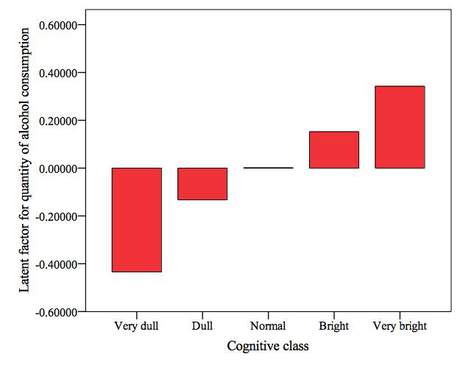
Distilled spirits are even more recent, dating from Middle East or China at about 700 AD.  On the Savanna Principle, we might therefore expect the frequency and volumes of alcohol consumption to correlate with IQ.  And so it does, even after variables such as sex, race, ethnicity, religion, marital status, education, income and social class are factored out.  The graphs show an increase in consumption for each IQ quintile, from below 75, 75-90, 90-110, 110-125, and 125+. “Very bright” British children grow up to consume alcohol nearly one full standard deviation more frequently than their “very dull” classmates.  And there are similar results for adults.

To sum up the argument:  because alcohol is recent, you’d expect high IQ people to be more at ease with it, and this is born out by statistical evidence.  I am at a loss as to what to make of this, or what its implications are.  The sneaking possibility that suggests itself is that drinking might lead to a more satisfied lifestyle, which is why smarter people tend to do it.  I wonder if there are any public policy implications in this?