Posted on February 26, 2013 by Madsen Pirie

The European Union hs always had a problem of political elitism. It has been directed by a political and technocratic class that does not, on the whole, share the values and aspirations of the European electorates. This class has usually managed to attain its agenda, sometimes by putting through very radical measures as if they were mere technical changes and extensions to its existing practices. When electorates have been consulted, as they have in the occasional referendum, they have shown a remarkable resistance to being led along by their betters into a bureaucratized centrally-run federal state they want no part of. It is pleasing to watch the discomfiture of the Eurocrats when this happens, and to follow the contortions they go through to override these expressions of popular opinion.
I was in Sweden when they voted on whether or not to join the Euro currency. In favour were all major political parties, business organizations, trade unions and most of the media. The people voted no, and must these days be congratulating themselves on having done so. As elections are held, especially in the southern countries most affected by a centrally imposed austerity, it is interesting to see whether or not the electorates do as they are told. I like it when they do not, and this now seems to have happened in Italy.
Filed under: Updates | Leave a comment »
Posted on February 25, 2013 by Madsen Pirie

For over 30 years I have occasionally enjoyed a cocktail of Courvoisier cognac and Grand Marnier mixed straight up in a balloon glass without ice. My friends and I call it a Lord Madsen. There is also a superlative quality Nicaraguan cigar which bears the same name, and doing an ‘LM2’ means enjoying both together. I thought I’d invented the cocktail, which treads the same road as a Brandy and Benedictine (B&B) by cutting back a liqueur with some of the spirit it is derived from. A couple of bars in DC used to feature my cocktail (and maybe still do) in their bartender’s book.
Now I discover that the combination is much older. Bartender Giusepi Cipriani founded Harry’s Bar in Venice in 1931 and gave us many cocktails, including the world-famous Bellini. He is reported to have invented a cocktail of Hennessy cognac and Grand Marnier at Harry’s Bar in 1948. He called it the ‘Beautiful,’ and it is the same thing as a Lord Madsen, since the Courvoisier can have any liqueur cognac substituted for it. It is such an obvious combination that my guess is that hundreds of people might have stumbled upon it independently. People cut back Drambuie with Scotch and call it a ‘Rusty Nail’ in similar style. Oh well. Since Cipriani seems to have been the first to publish it, I guess he gets to name it. But ‘Beautiful’ is not a very good name. It is an adjective, not a noun, and if you ask for ‘a Beautiful cocktail’ you are quite likely to be handed any cocktail the bartender thinks is beautiful. I shall continue to call mine a ‘Lord Madsen.’
Filed under: Updates | 2 Comments »
Posted on February 24, 2013 by Madsen Pirie

At one time I lived quite close to Hinchingbrooke Hospital, which had fallen into poor service. It recorded one of the lowest rankings in the area for patient satisfaction, and was nearly at the bottom for waiting times, with many patients required to wait over 4 hours in Accident and Emergency. Then last year the running of it was handed over to Circle Holdings on a 10 year contract. The company’s operating subsidiary is 49.8 percent owned by a staff partnership.
The results have been immediate and dramatic, says a Telegraph report. Patient satisfaction is now 85 percent, putting it in the top 6 of the region’s 46 hospitals. Losses have been cut down to £3.7m instead of the anticipated £10m, and the company will soon start to pay off the old debts previously incurred. The formula is simple, and involves cutting paperwork and giving decision-making power to doctors and nurses.
This offers a way out of the NHS’s appalling problems. Its hospitals could follow this model, with the running contracted out to a consortium involving the staff. The next stage will be to remove the central bureaucracy by giving ownership of the hospitals to their communities. Step by step we now have the chance to replace the NHS by a better, more responsive, and more caring system of health care.
Filed under: Updates | 1 Comment »
Posted on February 23, 2013 by Madsen Pirie

Brian Micklethwait has published on Samizdata a lengthy review of ‘Think Tank,’ the book about the ASI, and about the work of the Institute itself. He clearly enjoyed tales of the early history of the ASI, a hand-to-mouth existence threatened by bailiffs and bank managers. He likes, too, the enthusiasm we bring to the task of developing sound policies that can appeal to politicians. Most of all Brian seems to like our youth outreach programme, done through talks to schools and universities, the monthly receptions of The Next Generation group, the twice-yearly Independent Seminar on the Open Society, and our programme of getting sound books into the hands of teachers, students and school libraries. Brian writes:
“Yet throughout this time, the ASI has probably done more to spread libertarian and free market ideas among students than anyone else, and I don’t just mean among students in Britain. By connecting the freedom message to the world of politics, and I do mean the world, they have kept the basic message interesting, fresh, newsworthy, relevant.”
High praise indeed. I rather think that it must also be obvious to outsiders that the young people who associate with the ASI are not only very intelligent and motivated, but they have a lot of fun, too. Long may it continue!
What the Adam Smith Institute did
Filed under: Updates | Leave a comment »
Posted on February 22, 2013 by Madsen Pirie

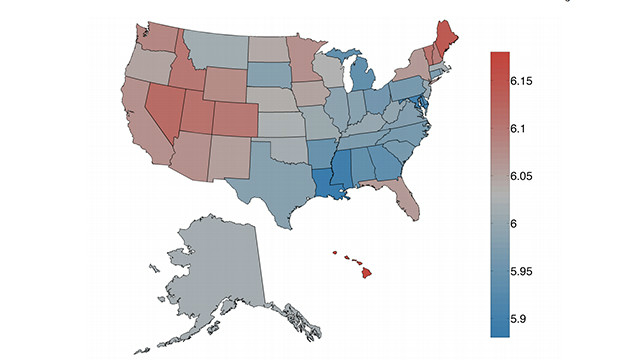
University of Vermont researchers have produced a novel and highly original piece of research to establish the different levels of happiness in different states of the US. Most happiness research is highly subjective, asking people to rate themselves in one of five categories ranging from very happy to very unhappy. The problem with this is that standards vary between people and sometimes over time for the same person. What the researchers did was to trawl through 10 million tweets looking for words that are markers for ‘happy’ or ‘unhappy,’ using the Mechanical Turk Language Assessment word list.
“The list includes 10,000 words that have been rated on a scale 1 to 10 according to how “happy” they are. On the lower end of the scale are negative words such as mad, hate, no, boo, smoke and jail, as well as a colorful and thorough assortment of expletives. Happy words include the omnipresent LOL and haha, as well as good, nice, sleep and wine, and food or beach related words.”
Of course the word list is open to question. I find that using profanity as a marker for unhappiness is highly questionable. I know many happy people who swear a lot. And the marginal propensity to tweet would influence the outcomes. Are Texas people really less happy than New Englanders, or do they just tweet less about it? Despite these reservations, the findings seem to be telling us something. It looks as though people in states with the most obesity problems are less prone to tweet ‘happy’ posts than those in the others. It looks as though the northeast states and the southwest post more ‘happy’ stuff than do the midwestern or southern states. (For those who don’t click the link, dark red indicates most happy and dark blue is less happy). It’s a fascinating new methodology.
Filed under: Updates | Leave a comment »
Posted on February 21, 2013 by Madsen Pirie

I continue to be impressed by the highly talented Allister Heath, Editor of City AM. His prescription for what UK Chancellor George Osborne should do now is spot on, and something I am in total agreement with. His recipe? Slash Corporation Tax to 11 percent and abolish Capital Gains Tax. Yes, the shortfall in revenue will widen the deficit for a time, but then spectacular growth will kick in to raise the tax base. I also agree that minimum wage earners should be taken out of income tax and national insurance altogether, and that planning laws should make house-building easier. We need to give growth a boost, and there is no doubt that Allister Heath’s recommendations would do the trick.
Filed under: Updates | Leave a comment »
Posted on February 21, 2013 by Madsen Pirie
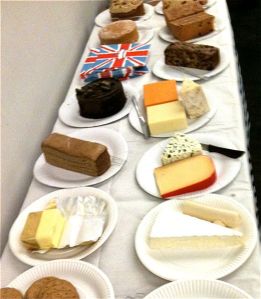
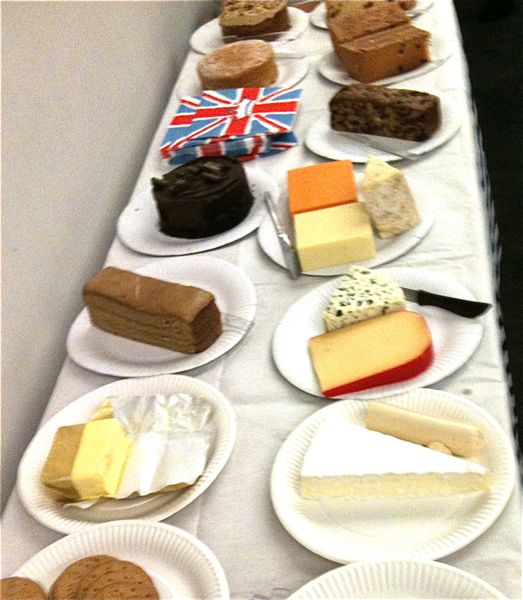
On Tuesday I hosted a party for some students at University College, London. It was held under the auspices of UCL Conservative Association, but included libertarians and other free marketers as well. I offered vintage cava, which I actually prefer to the cheaper champagnes. Price for price I find it much better. UCLCA provided soft drinks for teetotallers and those who had given up alcohol for Lent. Cheeses included brie, Austrian smoked, stilton, Danish blue, mature cheddar, red Leicester and Edam, with both crackers and sweetmeal biscuits to eat with them. While many people lay on wine and cheese parties, my innovation is to add cakes. I provide a variety of different types of cake, including chocolate, soft fudge, cherry Madeira and fruit cake amongst others. I find that student guests tend to snack on the cheeses, leaving the cakes untouched for the first half an hour. Then quite suddenly they start on the cakes, which disappear with amazing speed. The party went well, and everyone seemed to enjoy it. There’s no magic really. Just good drink, good food, and good company. It’s as simple as that.
Filed under: Updates | Leave a comment »
Posted on February 20, 2013 by Madsen Pirie

There seems to be a mindset in the media that a company’s value to the country’s economy consists entirely in the taxes it pays to the Treasury. This is completely wrong. A company can be of immense value to society even if it pays no Corporation tax at all. Companies create jobs and employ people. They pay wages to those people who then pay tax on those wages and VAT on things they buy with them. Company personnel pay taxes when they fly, when they buy insurance, when they buy houses. They buy supplies and machines to make their products with, and pay VAT on those. Because we want to encourage the investment that brings growth and prosperity, we allow firms to offset their costs against their returns when tax liability is assessed. An expanding firm might take years to achieve a net surplus of inflows over investment and expenditure, creating liability for Corporation Tax. Even though it paid no Corporation Tax during that period of expansion, it was of immense value to its country’s economy because of its economic activity. It’s what they do that counts, not what they pay. And one must add to this the value to people of the goods and services they produce…
Filed under: Updates | Leave a comment »
Posted on February 19, 2013 by Madsen Pirie

The aftermath of the financial crisis has produced much talk of the income gap between rich and poor. This is essentially about equality, although some try to define poverty in terms of the gap, describing as ‘poor’ those who earn less than 50 percent (sometimes 60) of the average wage. Absolute poverty is about not having enough resources to secure a decent standard of living in terms of food, clothing, shelter and services, rather than about how rich some other people are. People at the bottom end of income distribution tend to care more about whether than can get by, rather than about how far above them the rich might be. One commenter on my recent Daily Politics appearance wrote:
“I’ve worked in around 60 countries, often among the poorest people, and not one of them has ever complained about income-disparities between poor and rich, only giving hope that they might earn a little more in the year ahead; only guilty elites, in poor countries and rich ones, fret about the income gap.”
Some have produced carefully selected statistics to argue that people are happier when income disparities are low. But other research has indicated that people are happier when they see opportunities for advancement, regardless of how rich or how unequal the society is. On the whole I side with the latter view, even while recognizing that a desire to emulate others can be a powerful motivating force. To reduce the income gap you have to take money from high earners and use it to increase the income of low earners. This prompts the obvious question: “If you are entitled to some of my money, how much of it do you have the right to?” And the further question: “What is it that gives you that right?”
Filed under: Updates | Leave a comment »
Posted on February 18, 2013 by Madsen Pirie

In that discussion on Daily Politics I at one point said, “When the rich get richer, the poor get richer, too.” This was taken by one commenter to be a reference to ‘trickle down’ economics, but it was not really. ‘Trickle down’ theory supposes that tax cuts on the relatively well-off will boost the economy as a whole, benefitting those not so well-off. I was instead alluding to the fact that the rich mainly get richer by selling goods and services that others want to buy. They do this by investing in the production of goods and services, thereby creating jobs and demand for producer goods that creates other jobs. Those jobs benefit poorer people. This means that the rich, in the act of getting richer, also boost prospects and living standards for the poor.
Furthermore, as Thomas Sowell has pointed out, the investment comes first. The entrepreneur hires employees and contractors, and buys materials before his or her product reaches the market and brings in returns. It is investment, not spending, that boosts growth. High taxes make investment less attractive by diminishing the returns that will accrue. In 1990 Congress slapped a 10 percent tax on yachts priced above $100,000, but had to repeal it three years later because it cost thousands of jobs in Florida and Maine as people built boats in places like the Bahamas instead. The best prospects for the poor come when society as a whole grows richer, rather than when governments concentrate instead on redistributing from rich to poor.
Filed under: Updates | Leave a comment »
















 Madsen Pirie