

• Adam Smith Institute

    Adam Smith Institute place holder
  • Philosophy & Logic

    Philosophy and Logic
  • Cambridge

    Cambridge
  • Children’s SF

    Children's Science Fiction
  • Enter your email address to follow this blog and receive notifications of new posts by email.

    Join 428 other subscribers

The Zboard is described as the Segway of skateboarding

The Zboard is a motorized skateboard equipped with motion sensors that detect your body movements and translate them into directions for the skateboard.  Lean forward and it accelerates; lean backward and it brakes.  Similarly appropriate leaning steers it to the left or right.  The basic model (at about $650) goes up to 18mph with a range of 5 miles.  The battery charges in 5-6 hours, and drives a 400W motor.  The board measures 40 inches by 10.5 inches, and is quite heavy at 35 lbs.  It looks pretty awesomely cool.
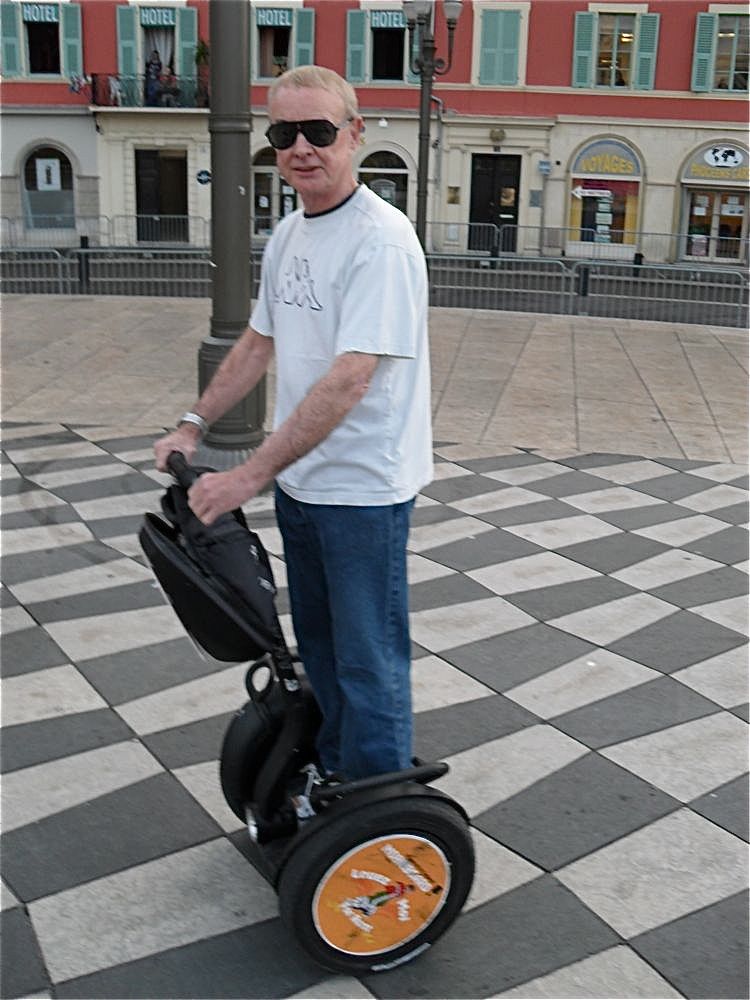
I’ve ridden Segways many times.  They are a popular feature used to traverse Nice’s Promenade, or to explore its Old Town.  I was surprised how intuitive they are.  It took me about 8 seconds to acquire the knack of riding one.  I became sufficiently adept that they let me ride it a few times with the speed restrictor disabled so I could fairly zip along on the thing.  I’ve several times taken friends with me, and all report how easy they are to ride.  The Segway is very heavy, though, and very expensive at several thousand dollars each.

Watching the BBC guy riding the Zboard has tempted me to try it.  It looks both easy and intuitive, and if you do come off, there isn’t far to fall.  It might encounter the same problem the Segway does in the UK, namely an anally-retentive Department of Transport that classifies it as a motor vehicle than can only be ridden on roads, competing for space with buses and lorries.  Obviously both devices are for pavements (aka sidewalks) and would put their riders at great risk of their lives among motor vehicles.  A group of MPs is trying to have the classification changed, but our bureaucrats are ineffably stupid as well as wilful.

Bono gets it right on aid, enterprise, capitalism and economic development, and backs tax competition, too

bonoI’m a fan of U2’s Bono for several reasons.  I like his music and his singing for one thing; he’s been a star performer for decades.  Secondly, I liked it when he featured me on his website, having discovered that the Adam Smith Institute advocated forgiving much of third world debt even before the churches launched their ‘Jubilee’ project for the Millennium.  Then recently he told Georgetown University’s Global Social Enterprise unit that capitalism and business were the solution to third world poverty.  He described aid as “just a stop-gap,” pointing out that commerce and entrepreneurial capitalism lift more people out of poverty than aid does.  He described entrepreneurship as “the most sure way of development.”

At a time when much of the aid brigade mixture of NGOs and celebs are busily denouncing capitalism and multi-nationals, Bono is hard-headed enough to recognize reality when he sees it.  Countries don’t get rich by having wealth given to them by others: they make it for themselves by trade, business and economic enterprise.  They need opportunities and markets to create their own wealth, as has been happening in China and India.  He recently told the Guardian:

“My father was Labour, classic Dublin Northside household. And I still carry that with me. And though I believe that capitalism has been the most effective ideology we have known in taking people out of extreme poverty, I don’t think it is the only thing that can do it, and in some ways I wish it wasn’t.”

He thinks that while other things might help people out of poverty and subsistence, capitalism is the most effective.  So the solution is not socialism or some ‘third way.’  It is capitalism.  He even found time to respond to calls for global tax harmonization to prevent countries engaging in tax competition.  Of his own country, Ireland, he said:

“Tax competitiveness has taken our country out of poverty. People in the revenue accept that if you engage in that policy then some people are going to go out, and some people are coming in. It has been a successful policy. On the cranky left that is very annoying, I can see that. But tax competitiveness is why Ireland has stayed afloat.”

A big round of applause for Bono, please, for recognizing the benefits brought by business and enterprise, and the recognition that it flourishes best under mild rather than onerous taxation.

Picking free food from the hedgerows

brambles2This is a bumper autumn season for fruit.  In the UK we have a “magnificent” crop of apples, and plums have been good.  I’ve been making fruit compotes with apples, plums and blueberries.  But one really nice autumn treat is brambles, and there are plenty of them this year.  In England they are called blackberries, but in parts of Scotland they are called by the same name as the bush that produces them.  From the Isle of Arran comes a delicious bramble and pear jam that a friend brings me back.  However, the real delight is free food plucked straight from the hedgerows, and that’s what I was doing in Cambridge last weekend.

The great thing about brambles is that they don’t all come at once.  Over the course of more than a month different parts of the bush produce ripe brambles.  I spent a happy twenty minutes in the sunshine picking enough for maybe three apple and bramble crumbles or pies.  I’ll be able to do the same for the next few weekends.  They are nutritious as well as tasty, with a lovely sharp tang that is softened by brown sugar.  Wild brambles are not as big or as luscious as the cultivated variety available from shops or market stalls, but they are packed with taste.

Brambles freeze well.  I wash them and dry them before popping them in the freezer.  When taken out to use in pies and crumbles they taste just the same as fresh ones, and they keep for months.  You rarely use them by themselves because they seem to go naturally with apples, though I have used them to make blackberry syllabub and blackberry fool.  It’s not just the taste; the fact that they are free food picked yourself from the hedgerows is part of their charm.

How diet features among the five factors that influence a person’s chances of suffering heart disease

health-dietA heart surgeon once told me that we play a five-card hand with heart disease.  The five factors are heredity, smoking, diet, exercise and stress.  He said that heredity was a stronger card than many people supposed, but that the other four cards counted.  You make yourself less likely to suffer heart disease if you quit smoking cigarettes, or at least seriously cut back on them.  If you avoid too many foods rich in saturated fats and eat more fish and vegetables you improve your chances.  Regular exercise, even light exercise like walking, is better than being a total couch potato.  Finally, lowering your stress levels helps out, though I found when I read up on this that there is a qualifier.  Stress you impose on yourself and can control is OK: it is the stress imposed on you by others or by circumstance that is the bad guy.  Some people can control stress by such things as yoga or meditation, but there’s a school of thought which says that diet can play a big role, too.

Dame Pinnock tells how choice of foodstuffs can lower the physiological effects of stress.  Oily fish such as salmon, tuna and mackerel, can help stabilize your mood.  Magnesium makes muscles relax and is found in green vegetables, and the B vitamins that can help calm and relax the nervous system are present in foods like asparagus.  Lastly, he says, you should keep your energy levels stable by combining a lean protein (like salmon) with a complex carbohydrate (like brown rice) plus vegetables.  It seems well established that children’s behaviour is influenced by diet, and that over-active children can be calmer if sugar-rich foods are replaced by more vegetables, so the use of diet to manage stress seems plausible.  We cannot yet do anything about heredity, but the other four cards can be altered by behaviour, and people have a choice on whether to do anything about them.  And it’s not just heart disease; acquiring beneficial habits has positive effects on your general health as well.

Violent campaigns against Golden Rice are among the most immoral of the fear-spreading tactics of environmentalists

golden riceAmong the worst excesses of environmentalist enthusiasts is the campaign against ‘golden rice.’  It is not just a campaign of black and misleading propaganda, though it is that, too.  It is also a campaign of property destruction and vandalism.  Greenpeace are among the most thuggish of offenders, claiming the right to override what elected governments have sanctioned, and using violence to secure their way.

Golden Rice has been genetically engineered to produce vitamin A.  It incorporates two genes, one bacterial and one from maize, that together produce beta carotene and then vitamin A.  This gives the rice its characteristic golden colour.  The point is that much of the world depends on rice for food, given that it provides 20% of the world’s calories, and rice is deficient in vitamin A.  It is estimated that 670,000 children die each year worldwide because of vitamin A deficiency, while hundreds of thousands more are left blind, and many more suffer other illnesses as a result.

Golden Rice is not about profit.  It has been developed free and open source.  Monsanto does not own it, and does not take royalties on any of its techniques used in its development.  The intellectual property is provided free.  The initial crop provided relatively low levels of vitamin A, but Golden Rice 2, the newer version, provides much more.  Indeed, a cup a day could provide half the recommended dietary intake of vitamin A.

The most recent vandalism has been the destruction of experimental fields in the Philippines, setting research back many weeks.  Locals were incited by environmental activist organizations from rich Western countries, who routinely try to spread fear about the new crop in order to prevent its acceptance and use.  Greenpeace opposes the release of Golden Rice in order to maintain its stance against all genetically modified organisms.  Their alternative remedies to vitamin A deficiency include a belief that by “home gardens, sustainable systems are created that provide food security and diversity in a way that is empowering women and protects agro-diversity.”  While it might be nice if subsistence farmers grew courgettes, carrots and cucumbers, the reality is that rice is cheap, easily grown, and provides enough calories to survive on.

Golden Rice has shown neither health nor environmental problems in its years of being grown and developed.  On the contrary, it represents science at its best, applying ingenuity and compassion to the solution of human problems.  One wonders how many children’s coffins will have to be dumped on the environmentalists’ lawns before they abandon their ideological and fanatical opposition to a life-saving technology.

Mathematical models do not seem to enlighten us any more about the past than they do about the future

mounted archerI have expressed doubt before about the use of data about the past to predict the future.  In my book the future is inherently unpredictable.  We might project forward the big numbers such as life expectancy, age of marriage, and population size.  We can add likely economic trends, but even if we get all of these right it does not actually tell us what the future will be like, and even less, what it will feel like to live in.

I have flagged up my skepticism concerning ‘cliodynamics,’ with its use of mathematical modelling to predict the grand movements of the past, present and future.  I compared it to the fictional ‘psychohistory’ used by Hari Seldon in Isaac Asimov’s “Foundation” series.  Now my skepticism has been reinforced. A new paper suggests that war, rather than agriculture, led to the formation of complex societies, and uses mathematical models and statistics in an attempt to validate this claim.  Some of the points made by Peter Turchin in support seem very naïve.

“You cannot have a large state without bureaucrats, but bureaucrats are expensive. You have to pay them,” he says. “So the big question is how do complex societies evolve when they are so expensive?”

The notion that war enabled societies to become complex and employ bureaucrats seems convoluted.  We all know that human societies have engaged in war, just as tribal ones do today.  War was assumed to be the norm between Greek city states.  Agriculture is also a factor, in that people no longer depended on what they could catch or could find.  Land became important, and peoples occasionally fought over it.  Agriculture generated surpluses and people fought over those.  All of this is mainstream,

“To test the two competing theories, Turchin and company designed two mathematical models for predicting the spread of complex societies. One based only on agriculture, ecology and geography. The other included those three factors, plus warfare. Then, they used data from historical atlases to determine whether these models matched up with the way the different states and empires actually evolved.”

Lo and behold the model that included warfare explained 65% of the variance, whereas the agriculture model only managed 16%.  But as I said, no-one has supposed that agricultural societies did not engage in war.  I note that their models did not include population data, and I have yet to see precisely how they defined the ‘complexity’ of different societies.

It is when Turchin talks about more recent times that my disbelief rises even more.  Talking about competition between societies, he tells us that workers were paid more in the 1920s because US companies voluntarily gave them more money out of a fear that Soviet communism might spread.  Oh dear.  I wonder if all the bosses met in a room and all agreed to do this by a binding majority vote?  I think I prefer the more conventional account that companies competed for workers, and such things as mechanization and electrification made workers more productive and therefore worth more to their employers.  I rather think that if the mathematical models are constructed using facile assumptions, then their findings are not going to be all that worthwhile.

A price freeze on energy is a sure way to guarantee a shortage

pylonsThe leader of the UK’s Labour Party, Ed Miliband, has promised a price freeze on energy if his party is elected.  This, he says, will help people by keeping down the cost of living.  He says it will save households £120 a year and businesses £1,800, costing the big energy companies £4.5bn.

In Miliworld the energy firms say something like “Oh dear. We’re making less profit now there’s a cap on prices. I guess we’ll just have to settle for less money.”  In the real world investors say something more like, “Ah, I see we’re not getting the returns by investing in energy firms.  OK, we’ll transfer our money to where we can obtain better returns on it.”  And the boards of energy companies say something like, “The price cap means we’ll have to cut back on the development of new sources because we no longer have the resources.  We’ll abandon that planned investment in exploration and development of new oil and gas fields.”  The result is less investment in energy.

In Miliworld people like the fact that energy prices are kept down.  In the real world cheap energy leads people to be less careful about economizing and to use more of it.  Demand rises even as supplies diminish, and the result is power shortages, rationing and blackouts.  In Miliworld when wholesale energy prices rise the big distributors shrug their shoulders and lose money.  In the real world they find themselves outbid for supplies by bidders elsewhere who can pass on some of that price rise to their customers.  Again, power shortages, rationing and blackouts.

This could be called the economics of the 1970s if it were any kind of economics at all, but it isn’t.  It is economic ignorance so profound that it isn’t even GCSE level.  One is left with one of two conclusions: that the people behind this policy are so depraved with power lust that they will happily accept future energy shortages as a price worth others paying if it gets them elected.  The other is that they are complete and utter morons.

An after lunch sleep could boost brain power and creativity

sleeping-childAn article in the Proceedings of the National Academy of Sciences has given details of a small study of 40 youngsters into the effects of a post-lunch nap.

The study by University of Massachusetts Amherst researchers has revealed that a siesta after lunch saw children perform significantly better on visual-spatial tasks, a benefit that continued into the following day.  It is more accurate to call this a siesta rather than a nap, since it involved an hour’s sleep after lunch.  Children allowed to do this later recalled 10 percent more information than the control group which had not slept.  The brains of the sleeping children were monitored and showed increased activity relating to regions linked with learning and the integration of new information.

It is well established that the brain reprogrammes itself and reassigns memories during the rapid eye movement phases of dreaming sleep.  This seems to present some evidence that a similar daytime effect occurs during a daytime snooze to improve cognitive abilities afterwards.

I have anecdotal support from my own experience that lends support. For many years now it has been my habit to take a nap after lunch.  It is by no means an afternoon siesta because it is very short.  I lie down and fall asleep without setting an alarm.  It is never less than 8 minutes or longer than 25, and nine days out of ten it is exactly 12 minutes before I wake up fully refreshed and alert.  I know this because of a digital clock alongside.  I make no conscious effort to do this; it just happens that way.  So reliable is it than even if I have a meeting to attend in half an hour, I can sleep knowing that I will awake in time.  My friends and colleagues say I am more productive and creative after this nap, but I have never attempted to have this assessed or measured.  It seems that way, but this is not the same as hard evidence.  However, this new study on young children suggests that it might assist their development if a post-lunch sleep were routinely included in their day’s programme.

Disentangling whales trapped in fishing nets

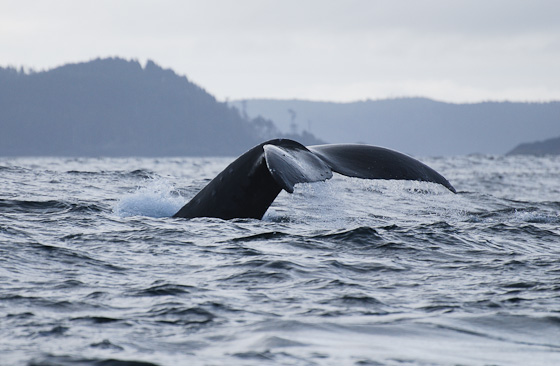
Langara Fishing AdventuresIt’s more complicated and more difficult than it sounds.  There’s a great BBC story about the Campobello Island Whale Rescue team that frees trapped whales caught up in or near Canada’s Bay of Fundy.  The animals struggle and make the work hard, so they tie polyurethane balloons around their fins to tire them out before they can successfully cut them loose.  It sounds pretty dangerous, too, but they do it because they like whales and want to help ones in trouble.  Volunteer Mackie Greene reports that humpbacks are easiest to work with.  They are used to people and often seem to understand what is going on.  He gets a real high after a successful release.

I share the fascination, as many people do.  I’ve followed grey whales off Santa Barbara, humpbacks off Provincetown, orcas off Vancouver and minke whales off Iceland.  There’s something about the creatures that fascinates.  Partly it is because we usually see only a fraction of their lives as they surface to breathe, and partly it is the sheer size of them.  And of course there is also their comparative intelligence.  They are by no means herbivores, given the plankton that many of them feed upon contains both animal and vegetable organisms.  And while many of them are gentle creatures, there is a real thrill when one surfaces alongside the boat and disappears with the huge fluke of its tail last to vanish under the waves.

Could this be a simple, natural way to remove carbon from the atmosphere and store it?

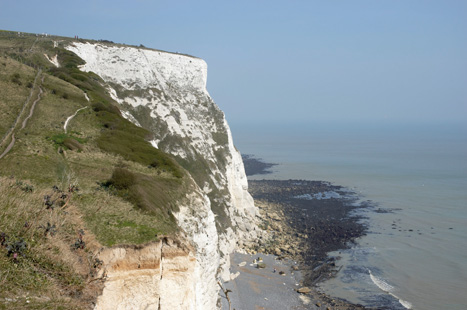
28 White CliffsMany methods of carbon sequestration are quite high tech.  In some cases the carbon is removed as CO2 during the industrial processes that produce it, then converted to an easily transportable solid or liquid, then buried beyond reach in deep caves or under oceans in now-dry oil or gas wells.  There’s a promising new idea, Kevin Bullis tells us in Wired, from scientists at the Santa Cruz campus of the University of California.  It uses the interaction of seawater on limestone, in much the same way that caves are carved out by the sea in limestone.

The process proposed replicates that and accelerates it.  CO2 in water makes the water slightly more acidic, and acts upon limestone to form calcium bicarbonate, the soluble salt that’s a constituent of hard water. When exhaust gases are exposed to crushed limestone, it is possible to remove 70 – 80% of a power plant’s carbon dioxide and put it into seawater as soluble calcium bicarbonate.  The salt already is in seawater as a result of natural processes, and there would only be a marginal increase in its concentration even if the world’s coastal power plants all switched over to this technology.  Many power plants already pump seawater for cooling, so the problem would be getting the limestone to them in sufficient quantities.  This calls for a pilot power plant to test that the system does indeed out as efficiently, cheaply and safely as it promises to.  Oh, and there’s a modest and unexpected bonus: the calcium bicarbonate could make the seas locally rather less acidic than they are being made by increases in atmospheric CO2.