



• Adam Smith Institute

    Adam Smith Institute place holder
  • Philosophy & Logic

    Philosophy and Logic
  • Cambridge

    Cambridge
  • Children’s SF

    Children's Science Fiction
  • Enter your email address to follow this blog and receive notifications of new posts by email.

    Join 428 other subscribers

Why the Cyprus levy on people’s savings is bad morality, bad economics, and bad politics

pickpocket

As part of the price they must pay for an EU bailout, the Cyprus government has agreed to impose a levy on the savings people have in the country’s banks.  Where these are less than €100,000 the levy will be 6.75%, but for savings in excess of €100,000 the charge will be 9.9%.  In return they are ‘compensated’ with worthless shares in worthless banks.  This is theft, pure and simple.  The Cyprus government is taking money from people simply because they own it.  It is not a tax imposed on a transaction, such as receiving wages of buying goods.  All taxes take money from people by compulsion, and are therefore a sometimes necessary evil, but taxes on wealth are the worst.  The state’s usual excuse, that it is justified in taking its cut because it provides and maintains the infrastructure that makes the transaction possible, does not apply to wealth taxes.  In most cases the money has already been taxed when it was being earned.  People who could have spent it chose to forego pleasure and save instead, with their money invested and creating jobs and opportunities for others.  It was not savers who caused the financial crisis, but it is savers who are being punished.

The signals this action sends out tell people that saving is foolish and that they should put their money in places other than banks.  The government has also reneged on the government deposit insurance, which signals that banks are now much riskier places than they were.  There will probably now be runs on several banks as people struggle to get their money out of reach of similar government action in the future, and shock waves will ripple across other European countries as savers start to wonder if their own deposits are safe.  From time to time the EU does amazingly stupid things, but this one is breathtaking.

Speaking to sixth-formers at Portsmouth Grammar School

ptsmth-grmr

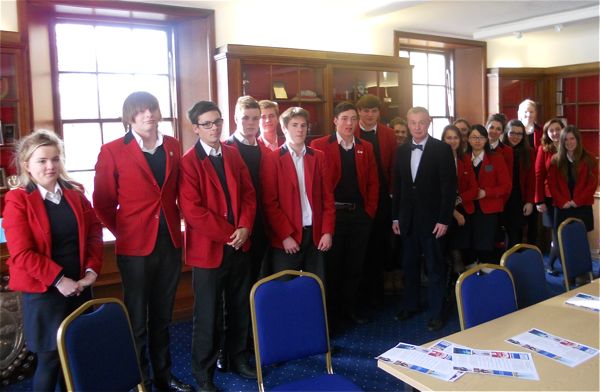
Portsmouth’s long association with British naval history is very evident today.  It also has a hovercraft service to the Isle of Wight and a busy harbour.  More importantly, it has a very good school, Portsmouth Grammar School, which invited me to address sixth-form students.  They were preparing for A-levels in diverse subjects including mathematics, economics, politics and history.  As is my norm with schools, I spoke for just under 20 minutes to leave plenty of time for questions.

In one question I was asked if joining the global economy was degrading the life of people in poor countries, as the industrial revolution is sometimes alleged to have done in Britain.  I replied that I thought both were untrue.  Pre-industrial life in Britain was not some rural idyll, but a life of degrading toil, squalor, starvation, disease and early death.  Life expectancy was in the low 30s.  The cramped city housing they moved into for factory jobs represented a step up.  Soon they were able to afford decent clothes, furniture, pottery and most importantly, they didn’t starve.

Similarly those in developing countries who move into manufacturing are advancing their quality of life, not degrading it.  They earn more, eat more, and have better access to healthcare and education.  Globalization has lifted more people from subsistence and starvation in two decades than has ever happened before in human history.  Over a billion people in China and India have been lifted into decent lives that abound with opportunities for advancement.  In my book that makes globalization one of the best things that people have done.

Recipe for making the Breakfast Martini

bkfst-marti

The Breakfast Martini was invented by Salvatore Calabrese, currently at Salvatore’s in London’s Playboy Club.  He created it in 2000 at the Library Bar of the Lanesborough Hotel, though there was an earlier similar drink, the Marmalade Cocktail, invented in the 1920s by Harry Craddock.  Calabrese came up with the drink after his wife insisted he eat a ‘proper’ breakfast in place of his usual coffee, a breakfast that included toast and marmalade.  The taste inspired him.

Ingredients:

50 ml gin (maybe two shots of Bombay Saphire), plus 15ml Cointreau, then 15ml fresh lemon juice, and finally 1 spoon of orange marmalade, thinly sliced

Method:

Mix all the ingredients into a cocktail shaker filled with ice, and shake for rather longer than normal to break down the marmalade. Strain into a chilled martini glass, then shred some orange peel on the top of the glass as a garnish. Mmmm. Delicious!

I’ll take the charcuterie, but only the full-price champagne, please

charc & champ

A City AM story reports that the cost of living index now takes account of the price of charcuterie meats, but no longer of champagne when it is on sale.  The Office of National Statistics looks at a basket of goods to help it track changes in the cost of living for average families, and its changes each year give us a snapshot of changing lifestyles.  This year full-price champagne remains in, but cut-price champagne is out.  Also newly included are spreadable butter, e-books and e-readers.  I’m glad that blueberries are now included with other berries in the basket, though not at all surprised that freeview boxes and computer games bundled with accessories have dropped out.  It is actually surprising how many things do make it into the basket, from dehydrated noodles to golf green fees.

The basket does actually matter, as well as telling us about what people now buy, because the Bank of England’s inflation target is based on the Consumer Price Index, and sometimes things such as pensions and wages are adjusted in line with its changes.

David Davis is eloquently sound about the government’s sensible U-turn on minimum alcohol pricing

David-Davis

Reports tell us that the government has abandoned plans to set a minimum price on alcohol of 45p per unit.  The idea was that this would somehow stop problem drinking, but there was no evidence that it might.  It was always poorly targeted, and backed most enthusiastically by those who oppose drinking per se.  In fact alcohol consumption in Britain is relatively low, and has been declining over the last decade.  It is by no means clear that a minimum price was even possible, given our EU treaty commitments.  Some countries sell us cheap wine, and increasing its price might be ruled anti-competitive and not in accord with the single market rules.  Scotland has passed such a policy, but it seems to be in trouble with the courts even before it is implemented.  There is a problem of binge drinking in Britain, and of excess drinking in Scotland, but no evidence that setting a minimum price would curb it.  Amid the hand-wringing and hysteria of those now thwarted in their attempt to make alcohol more expensive, the words of David Davis MP on the proposed price rise and binge drinkers came like a cool breeze of common sense.

“It won’t just hit those, it’ll hit poor people. It’ll hit people in the north. It’ll hit the pensioner having their one bottle of wine a week; it’ll hit the hard-up couple doing the same. It’s going to cost…it’s going to transfer £1billion from the public to the people who sell alcohol, and it’s not going to work.

“If you look at pricing across Europe, in Germany they sell beer at a pound a pint cheaper than they sell here. They sell in Spain the same, in France the same, and they do not have this problem. There’s a drinking divide in Britain, a cultural divide, and you will not solve it by this rather heavy-handed sort of mass effect that won’t actually stop the problem.”

People who enjoy drinking in moderation will say “bravo!”

Countering alarmism in a talk to Loretto sixth-formers

loretto(a)

I spoke at Loretto School near Edinburgh on Monday.  It was quite an effort getting there.  I had to get up at 6.0 am to go to Stansted Airport, and when my plane landed at Edinburgh there was a minor blizzard and no taxis.  Eventually some came, but traffic was so snarled up on snow-bound roads that I thought we wouldn’t make it.  What should have been a 35 minute trip to Loretto School in Musselburgh took nearly an hour and a half.

In my talk I countered some of the alarmism spread about by environmental lobbyists.  No, the world isn’t running out of scarce resources because our ability to extract from new sources is advancing faster than we are using them. No, we are not going to drown in a sea of humanity because population will level off at about 10bn.  Yes, we can feed them because of our ability to produce more food from less acreage, which will be enhanced even more by GM crops.  No, we won’t have water wars, we’ll just find cleverer ways, such as osmosis, to purify some of the four-fifth of it covering the planet.  No, we won’t run out of energy because there is over a century’s worth of gas reserves.  I knocked quite a few sacred cows on the head (to mix my metaphors), and I hope I made the students question some of the nonsense some people come out with.

This is not a good time for pro-EU federalists in the United Kingdom

EU & City

I was talking with a Liberal Democrat councillor who thought that things had been going rather well for those who supported more European integration.  I pointed to the Eastleigh by-election where the United Kingdom Independence Party had come out ahead of the Conservatives, and to the Italian elections, where Silvio Berlusconi had staged a comeback, and Beppe Grillo’s anti-establishment Five Star Party had also done well.  While conceding that neither of these results was particularly good for pro-Europeans, he thought the EU had redeemed itself by moving to ban banker bonuses of more than twice salary.  He thought that bankers were even more unpopular than Eurocrats, and that this would be popular.

The move is, of course, unutterably stupid.  It moves to stop reward being linked to performance, which provides incentive to do well.  The bonus system makes bankers’ rewards very elastic.  They can be high in times of success and be cut back in a downturn, unlike basic salary.  The first thing the new EU action will do is to give a massive boost to bankers’ salaries as banks bid to retain top people without a bonus system to do it with.  I doubt that “Eurocrats boost bankers’ salaries” headlines are going to go down all that well.  No, this was yet another downer for the pro-EU crowd, not least because it is finally tipping opinion in the City.  Bosses in the finance sector have long backed the EU because they liked the great size of its market.  Now more of them are coming round to opposing the incompetence of its legislators.

Do DNA tests show that we all have common ancestors?

DNA-ladder

Several scientists, including eminent genetic researchers, have reportedly criticized commercial companies that charge people up to £300 a time to learn if they are related to famous figures in history.  The recent discovery of Richard III’s last remains apparently prompted a surge in people wanting to know if he featured among their forebears.  Some scientists describe such tests as little more than “genetic astrology.”  The case is that after a few steps back up our family tree. We have very little DNA from each ancestor compared with that which we share from ancestors we have in common with others. Steve Jones, Emeritus Professor of Human Genetics at UCL says:

“On a long trudge through history – two parents, four great-grandparents, and so on – very soon everyone runs out of ancestors and has to share them.  As a result, almost every Briton is a descendant of Viking hordes, Roman legions, African migrants, Indian Brahmins, or anyone else they fancy.”

Fair enough.  I’m comforted by the thought that I have some of Julius Caesar’s DNA inside me, alongside the more obvious and more recent Viking DNA from my Danish ancestors.  Maybe it is a little like astrology, in that many people read their horoscopes every day for a bit of fun without seriously believing that the patterns of stars as they appeared in the sky at the time of their birth determine their future destiny.  These DNA tests might similarly give us a little fun, and some links we can amuse ourselves with, rather than telling us anything all that significant about our origins.

How Britain’s National Health Service has turned health into a zero sum game

NHS board

Yet another story has appeared about the so-called “postcode lottery” in the NHS.  If there is any kind of local decision-making, it follows that different policies will be followed, and different treatments will be available.  It is thought by many to be a good thing that NHS people in an area can take decisions they think appropriate for that area, but the result will be a postcode lottery.

“The number of patients undergoing common surgical procedures varies widely across England because of funding restrictions, figures show. Local NHS rationing of hernia repair, hip and knee replacements, cataracts and varicose vein surgeries has led to a ‘postcode lottery,’ say researchers.

And while there had been much debate about the “clinical value” of some elective surgical procedures, there was poor consensus on which treatments should be restricted to save costs, the Imperial College London team said.

The study’s author, Steve Beales, describes variation as “a bad thing” and calls for national guidance.  What the report does not point out is that procedures have to be limited because the resources needed for each – time, finance, personnel, space – cannot simultaneously be used for another.  This means that there have to be priorities as NHS managers decide on the priorities for each.  Money spent on keeping a premature baby alive cannot simultaneously be spent on keeping several kidney patients alive.  Resources used on varicose veins cannot be simultaneously allocated to hip replacements.

The NHS has turned health into a zero sum game in which spending resources on one person means that resources must be denied to another.  Within a fixed budget that caters for everyone, this is an inevitable result.  Access to NHS treatment is therefore competitive.  To campaign for more to be spent in one area of treatment means that less can be spent in another.  To demand an expensive drug for one treatment means denying drugs to other people.  This will happen whatever the size of the NHS budget.  The latest story exposes yet another failing of the entire structure of the NHS.  There will be no end of such stories because the NHS is a fatally flawed concept.  It is time for it to be wound up and replaced by a better system that allows more weight to the opinions of patients than it does to management decisions by so-called ‘experts.’

The part played by trial and error in making progress

trial&error2

The thesis I submitted for my PhD at the university of St Andrews was about progress and the methodology which can achieve it.  I take the view that progress must be aim-related.  If we do not have a clear sight of what we are trying to do, of what goal we are trying to attain, we will not be able to assess whether or not particular actions take us closer to it.  Thus in any field we have to start with an awareness of what the aim is.  We also have to be able to make attempts to reach that goal, to engage in behaviour that can take us closer to it.  These attempts are by no means random, in that they usually represent actions that we think might work.  Instead of random trials, these are nearly always inspired trials, suppositions on our part that they might bring us closer to or goals.  They must be testable, in that we need to try them out and check whether the results do indeed bring us closer to our aims.  They are not usually tested in isolation, but competitively against other actions, sometimes to see if they bring an improvement on what we have been doing hitherto.

People sometimes complain that while science has made progress by leaps and bounds, the area of our philosophical and moral lives seems to lack similar visible evidence of progress, as we tread and retread the same old ground.  A large part of this might be simply that we are agreed about what is the aim of science, and can therefore see when we reach closer toward it, whereas there is no such agreement about what is or should be the aim of moral philosophy.

Karl Popper thought the aim of science is to provide us with objective knowledge, truths about the universe, and that testing theories in an attempt to prove them false and eliminate them is the way to achieve a more concentrated core of truth.

I take a rather different view, that our aim in science is to increase our ability to predict what we shall observe.  We produce models in our mind that might help us do this, and test them to see if they do it better than previous or rival models.  If they do not, we discard them, not because we have proved them wrong, but because they are less effective than their competitors at helping us to achieve our aim.  These models do not constitute objective knowledge of the universe, just convenient ways of enabling us to predict it.  In my book Newton did not discover the theory of gravity; he invented it.  It is a human construct, better than its predecessors at helping us to predict what we shall observe.  My approach has science as a special case, albeit a very important one, of a general methodology by which we make progress towards our aims.