


• Adam Smith Institute

    Adam Smith Institute place holder
  • Philosophy & Logic

    Philosophy and Logic
  • Cambridge

    Cambridge
  • Children’s SF

    Children's Science Fiction
  • Enter your email address to follow this blog and receive notifications of new posts by email.

    Join 428 other subscribers

Changing the accent and speech to sound more educated

keep-calm-and-love-british-accents-23

A school in Middlesbrough has produced a list of incorrect words and banned its students from using them.  The aim is to enable the children to use correct English so they will not be discriminated against in job interviews.  The banned words include northern expressions such as “nowt,” “I dunno,” and “gizit ere.”

It is good that the teachers have the interests of their students at heart, and show concern about their future, and parents seem to be generally supportive, judging by press reports.

[The head teacher] said: “I don’t want the children to be disadvantaged. Using standard English in applications and job interviews is important. You don’t want the children to lose their identity, but you do want them to be able to communicate properly with people and be understood.”

She is correct in saying that people are judged by the way they speak. Whether or not this should happen, it certainly does.  We even say things such as “he spoke with an educated accent” that emphasize this.  I have on occasions helped friends who wished to change their accent to be more in line with Standard (southern) English.

In practice there are two sounds that matter, the short ‘a’ and the hard ‘u.’  In northspeak the ‘a’ in ‘castle’ is pronounced as a short vowel like the one in ‘cat.’  In southspeak it is long and rhymes with ‘parcel.’  In northspeak most of the ‘u’ sounds are hard, and the ‘u’ in ‘bucket’ is pronounced like those in ‘butcher’ or ‘sugar.’  In southspeak most of the ‘u’ sounds are soft, and the one in ‘butter’ is not pronounced as in butcher.  If those two sounds are changed, which most people can achieve quite quickly, the accent changes.  The more difficult one is the internal ‘g’ as in ‘singer.’  In southspeak this is more like a brief glottal stop, but in northspeak it is pronounced as in ‘finger.’  It takes longer to separate the words that do feature the internal ‘g’ from those that do not.  It would be good to have everyone able to fulfil their potential, and if their speech patterns or accent cause them to be judged unfairly, they should be able to change them.

Dream Chaser spacecraft is about to undergo flight tests

dream-chaser1

Dream Chaser, the spacecraft from Sierra Nevada Corporation, is being prepared for its test flights, Wired tells us.  This is one of three private sector competitors attempting to win NASA contracts to ferry astronauts to the International Space Station.  The entries from Boeing and SpaceX are both based on capsules, recalling the early days of the Mercury, Gemini and Apollo programmes.  Dream Chaser, by contrast, is more similar in concept to the Space Shuttle orbiters in that it will land on a runway.  There is a crucial difference, though, in that Dream Chaser is a lifting body, deriving its lift within the atmosphere from the shape of its body, rather than relying on wings as the Space Shuttle did.  Its hybrid rocket motors burn hydroxyl-terminated polybutadiene (HTBP) and nitrous oxide and can be stopped and restarted, unlike solid fuel rockets. Importantly, its reaction control systems use ethanol-based fuel, which is not explosively volatile, enabling the craft to be handled immediately after landing.  Its ablative thermal protection system is designed to be replaced in large groups, rather than laboriously tile by tile, and then only after several flights.  It will launch into space vertically atop a well-proven Atlas V rocket.

Given that NASA is likely to award two contracts in 2017 for man-carrying vehicles, there is a possibility that it will select one of the two capsule entries and award the other to Dream Chaser, thus covering two separate and very distinct concepts.

Zero Dark Thirty is a highly watchable movie, but probably not an Oscar-winner

zerodark

Zero Dark Thirty is longer than it needed to be.  To my mind it seemed competently put together rather than outstanding.  It tells of the ten-year hunt by the CIA to locate Osama Bin Laden, and of the subsequent raid on his compound in Pakistan.  Maya, the CIA agent, single-mindedly pursues the case and eventually tracks him down.  There are too many torture scenes, which are not only unpleasant, but pretty dull.  One would have sufficed to make the point that torture was used successfully to gain vital information.  The assembling of clues to track down Bin Laden’s courier and the use of electronic intelligence are both quite absorbing.  The high point of the movie, however, is the last thirty minutes of it depicting the actual raid by special forces in two Dark Apache (stealth) helicopters.  Even though we know the outcome, it is edge-of-the-seat stuff, with jerky camera work and infra-red to add to its realism.  I thought the movie well worth seeing, but I doubt it will win many Oscars (maybe best actress), given that it is up against Lincoln.

A living wage can be achieved by raising tax thresholds to minimum wage levels.

banknotes

The Living Wage Foundation campaigns to have UK employers pay their staff more than the minimum wage that is set by law.  Their campaign is not to change the law, but to encourage or to pressure employers into voluntarily paying higher wages than the legal minimum.  Their claim is that the current minimum wage of £6.19 per hour is insufficient for a decent standard of living, which they say requires £7.45 per hour in the UK outside London, and £8.55 within London itself.

There is certainly a good case on moral grounds for raising the incomes of the lowest paid and giving them access to opportunities currently denied to them.  There might, however, be some problems associated with a campaign to have this brought about by the voluntary actions of employers.  It might mean that those who paid the ‘living wage’ became less able to compete on costs with firms that did not.  It might, by raising wage costs, encourage the spread of automated replacements for labour, thereby reducing the number of low-paid jobs available.  It would raise the prices of whatever goods or services the employers were producing, meaning that customers, including those on modest means, would end up paying for it.

The Adam Smith Institute has what it believes to be a better idea, and has campaigned for over a decade to have it implemented.  Our proposal is to raise the income tax threshold to the level of the minimum wage, taking the lowest paid out of taxation altogether.  It seems bizarre, but the government, having set a minimum wage, then takes income tax from those who earn it.  Sometimes it then has to give benefits to them to make up their income again.  If people on minimum wages were exempt from income tax, their income would rise to within pennies of what is advocated by those who support a minimum wage.  Furthermore, the funds would come from the Treasury, not from employers, and could be paid for entirely by cuts in government spending.  It was the Liberal-Democrats, not the Conservatives, who inserted a pledge into the coalition document to raise the threshold to £10,000 during this Parliament.  Its current level is £8,105, rising this year to £9,205.  Bravo, but the minimum wage level would take it up to just over £12,500, so there is some way to go.  Our simple dictum is that people on the minimum wage should not be paying income tax.

An advantage of the ASI proposal that might prove attractive to the government is that a commitment to implement this would achieve a ‘living wage’ and shoot Labour’s fox in the process.

The US economy is improving (which is good for equities) despite one set of bad figures

Wall-St

The Dow Jones has reached a five-year high, passing 14,000 for the first time since 2007.  New Labor Department data showed that in November and December the US economy had added 127,000 more jobs than originally thought, giving a yearly average of 181,000 new jobs per month.  This comes just days after the news that, against expectations, the US economy contracted by 0.1 percent in the final quarter of 2012, an unexpected drop that many analysts nonetheless shrugged off as mostly down to steep cuts in defence spending.  There are other positive indicators for the US, such as a rise in the purchasing managers’ index, and the overall impression is one of a steady recovery well ahead of anything in the UK or the Eurozone.

All of the positive business news, which includes a rising industrial sector, points to steady growth, which is good news for those investing in stocks and shares. Combined with the money being pumped into several of the world’s economies and the low interest rates on offer, the indicators suggest that people might increasingly withdraw from bonds and move in to equities, as I predicted at the beginning of January.

“There’s a lot of money looking for a home and people are finally deciding the bond market is done and moving money into equities,” said Edward Simmons, managing director of Maine-based financial advisors HighTower.

My impression is that the US economy is now over the worst of it and into recovery.  Their belt-tightening and public sector cuts have far outclassed the relatively feeble measures taken in the UK, and now they are seeing an uptick in private sector investment.  Of course there are dangers and fiscal cliffs, not to mention the future tidal wave of unfunded entitlements. But for the moment they seem to have muddled through.

Police should not be engaged in commercial activity

It has now emerged in response to a freedom of information request that police forces have been paid millions of pounds in return for passing information about road accident victims to companies such as claims managers and lawyers.

“Three forces — Fife, Hampshire and the Metropolitan Police — have admitted giving the contact details of more than 16,000 people to third parties. It is believed the practice is adopted by other forces, although they declined to provide details to LV.  The Met admitted it had been paid more than £5million since 2009; Hampshire has received £480,000 since 2010, while Fife has been paid £194,000, a freedom of information request by LV Insurance found.”

It is yet another indication of how far the UK police have become separated from the civic-mindedness that should characterize the force.  Some of those whose information was passed on will have received the irritating cold calls and badgering that claims companies use to drum up business.

It emerged recently that some police officers were accepting money from journalists and paparazzi in return for information about celebrities and people involved in high profile cases.  It is quite wrong that police should pass on information to outsiders, and even more wrong that they should be paid for doing so.  Former Home Secretary Jack Straw has described the practice as “scandalous,” and this is one occasion on which I find myself in agreement with him.  Clearly, action must be taken to stop it.

Lincoln is a very intelligent movie

url

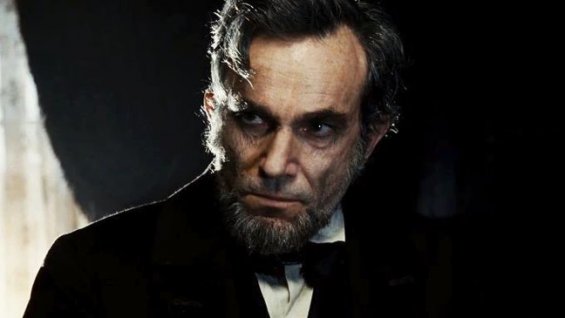
I saw the movie “Lincoln” and understood instantly that this might well will win 3 of the 4 big Oscars,. It could win best movie, best director, best actor.  After that it’s anyone’s guess.  It is very clever. It is a political movie, both enthralling and exciting.  The character of Lincoln emerges as a man, and a skilled politician at that, rather than a cardboard cut-out saint.  Endearing scenes show him as a father, spending time with his young son, even as tension and drama unfold all around him.  We understand as the man makes compromises and cuts deals to secure the one thing he believes matters more than all else.  If only Spielberg knew how to quit when he’s ahead.  The last 15 minutes added nothing to the total…. Even so, this is a gripping, must-see movie.

White elephant wind turbine proves unable to cope with wind

turbine crash

I make no secret of my skepticism about wind power.  The turbines use much energy and resources to build, and need back-up power for when wind doesn’t blow.  They are very expensive, and put up fuel bills.  They are noisy, unsightly, and kill birds.  Without tax-funded subsidies they would not be built.  Given that natural gas is cheap and abundant, thanks to fracking, wind power will be seen in the future as almost as big as mistake as bio-fuels, although to its credit it has not caused as many people to starve.

When a large one of them just crashed because it could not withstand the force of the wind, the description of the “mangled, blackened wreck with melted blades” seemed like a symbolic depiction of the policy itself.  May all policies that rely on tokenism rather than sense and calculation go the same way.

Introduction to falconry at the Birds of Prey Centre

falconry2

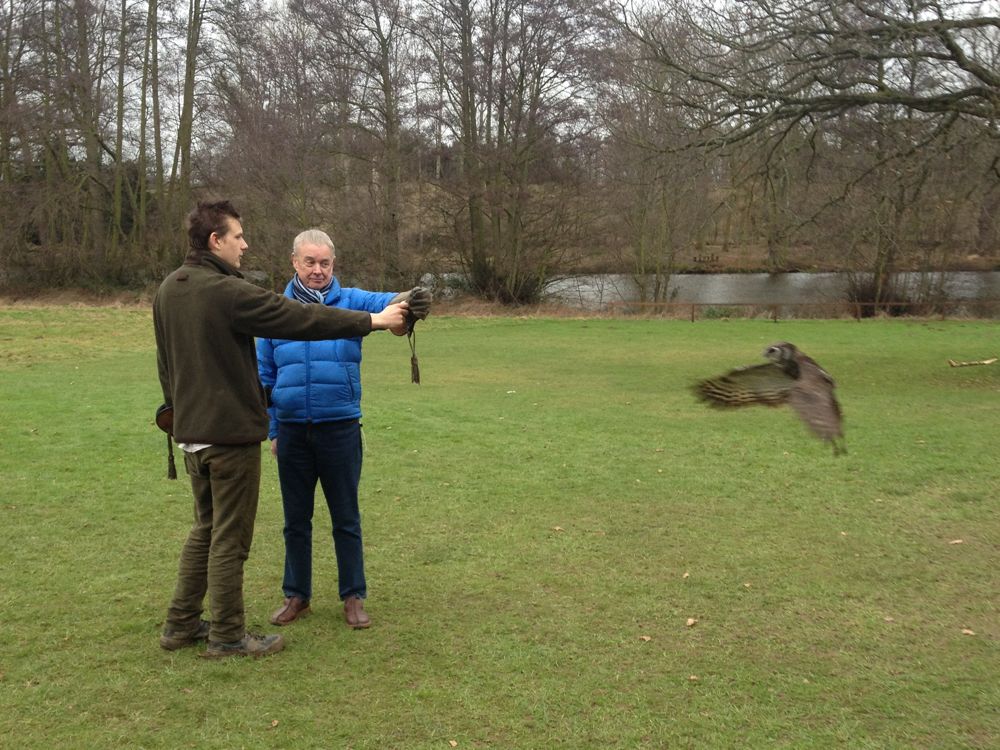
The second of my themed year ‘hobbies’ was falconry, following my one-day film school for the first.  For this one I went to the Birds of Prey Centre at Old Warden Park near Biggleswade.  They have over 300 birds of prey there, ranging from small owls and kestrels up to big golden eagles.  The introductory course began with handling the birds and growing accustomed to their presence and traits.  We began with small, quite exotic foreign owls, moving on to larger birds.  Then came several varieties of falcon.

The fun part came when the birds flew and came in to settle on my gloved outstretched hand.  The owls did this readily, but the eagles had to be encouraged by pieces of dead chick held in the fingers of the glove for them to fly up to, settle on the glove, and swallow whole.  It might not be for the very squeamish.  All in all it was a thrilling experience and a very rewarding time spent learning totally new things. Oh, and I had to repair a three-inch gash in the sleeve of my down jacket, caused by the talons of an eagle that slightly misjudged where the glove was.

Some points about the proposed High Speed Rail Link

HS2

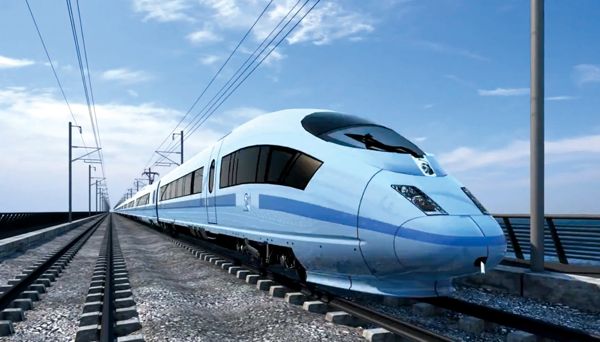
Yesterday saw the announcement of the likely route for the second stage of Britain’s proposed High Speed rail link, with connections to cities north of Birmingham.

“The preferred route of phase two goes north from Birmingham along two branches, with new stations at Toton near Nottingham, Sheffield, Leeds, Manchester and Manchester Airport.”

It occurs to me that with some stations being built far away from city centres, the actual point-to-point journey time might not be all that much less than can be achieved today with travel to and from the centre of cities.

While George Osborne and some business leaders are talking of an “engine for growth” and a boost to the economy, it will cost a great deal of money that might otherwise have been spent on other things.  If government takes it in tax, it denies the economy the benefits it might have brought if spent privately.  Furthermore, it will be a long time in coming.  The lines might open in 2032-2033, nearly 20 years away.  Who knows what the economy will look like by then, or what it might benefit from?  I admit it is a bold, exciting project, but I have my doubts about its economic validity.  This is a big, expensive project that might shorten journey times a little for a comparatively small number of people to whom this matters.